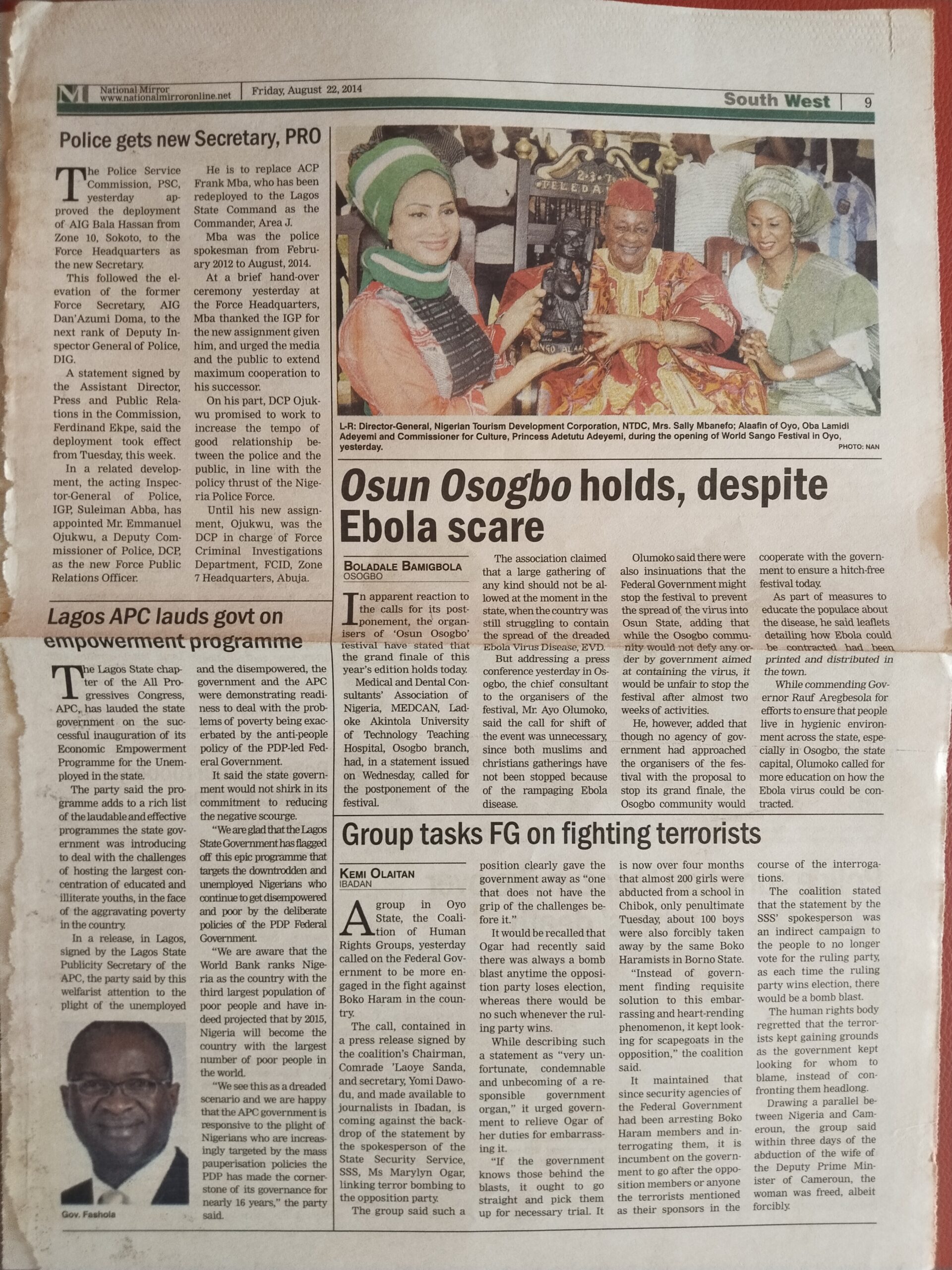
42 COUNTRIES TO GRACE WORLD SANGO FESTIVAL
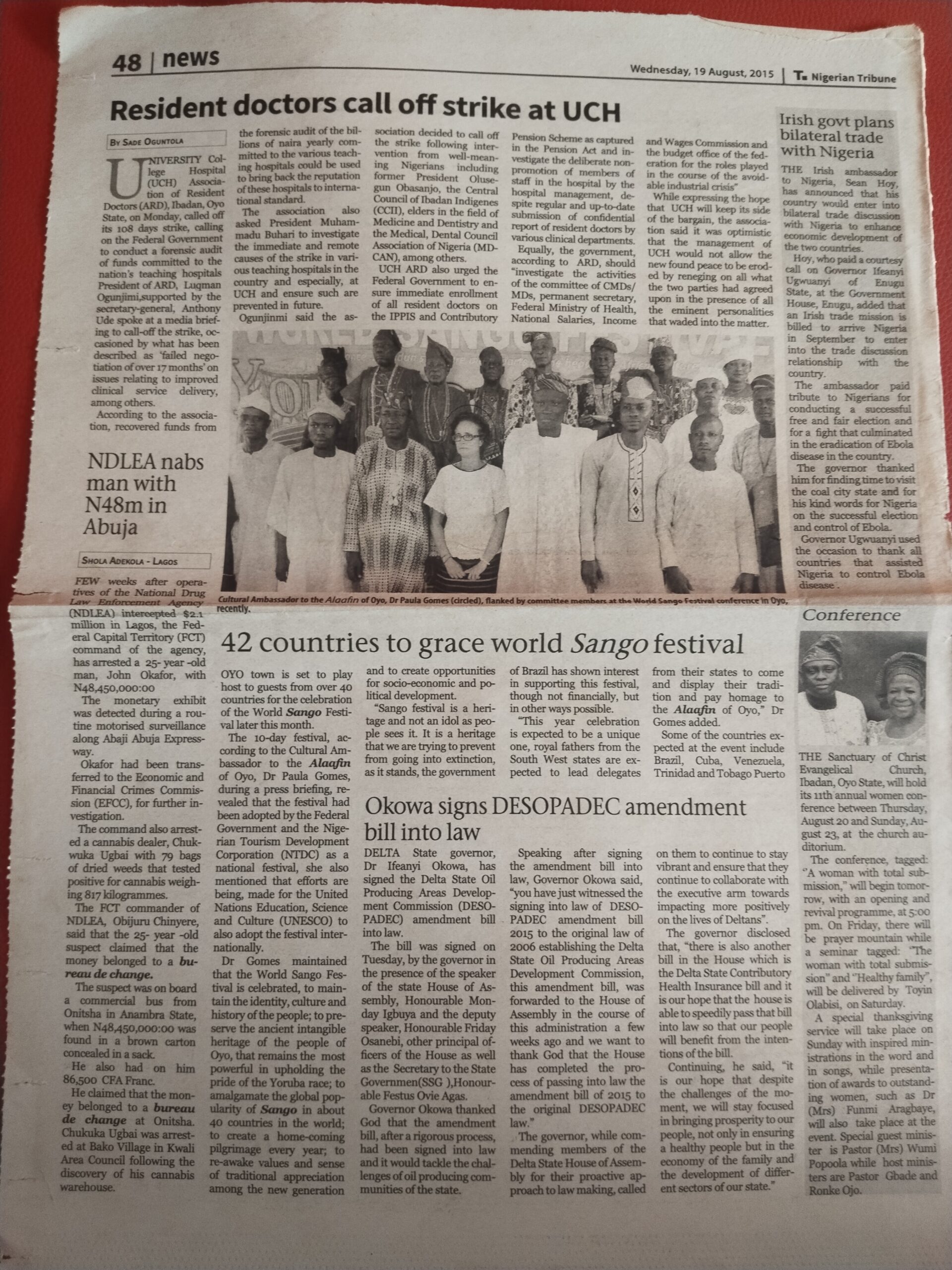
OYO town is set to play host to guests from over 40 countries for the celebration of the World Sango Festival later this month.
This year celebration is expected to be a unique one, royal fathers from the South West states are expected to lead delegates from their states to come and display their tradition and pay homage to the Alaafin of Oyo,” Dr Gomes added.
WORLD SANGO FESTIVAL: CELEBRATING MIX OF CULTURE, POWER
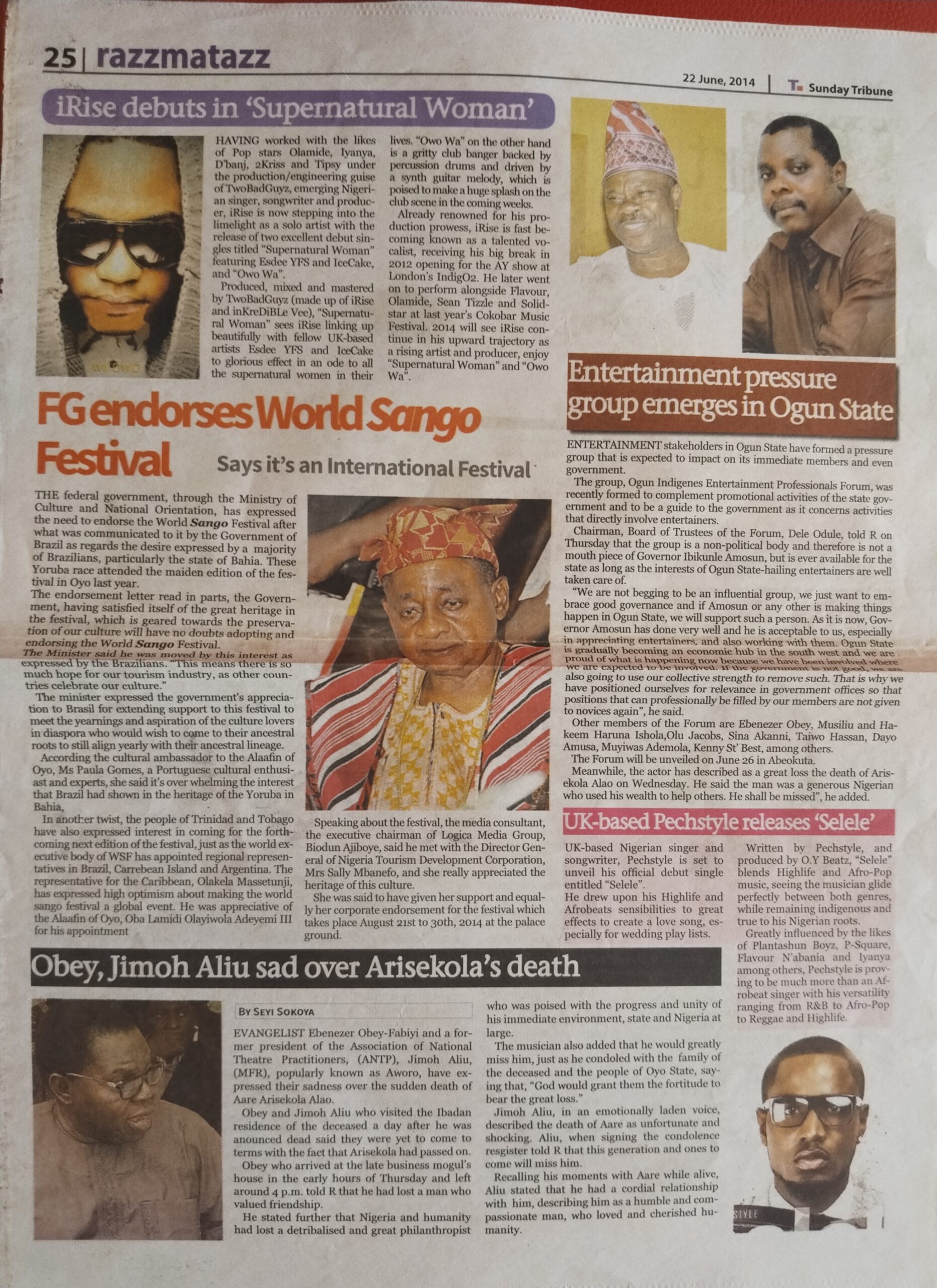
Nigerian Tribune, Tuesday, 27, August, 2019.
In Yorubaland, the month of August plays host to different cultural festivals. From Ekiti to Osun through to Oyo, it has been mammoth crowd converging to witness those traditional gatherings. The World Sango Festival was held in Oyo last Saturday and left enduring mark in the memories of tourists who thronged the palace of the Alaafin of Oyo, Oba Lamidi Olayiwola Adeyemi III
. TUNDE BUSARI captures every moment of the crowd-pulling festival.Unlike regular masquerades most of which appear in multi-colour costumes, the all-black apparel adorned by the duo of lnayodudu and Danafojura, lightened up the grand finale of the annual World Sango Festival held in the palace of the Alaafin of Oyo, Oba Lamidi Olayiwola Adeyemi last Saturday. The respective performances of the masquerades showcased mystical side of Yoruba culture and indeed reinforced the potency of the Yoruba research on nature. First to perform was Inayodudu, who attended the Sango Festival with his followers from his Igboho (Oke-Ogun) base. At a point, almost the whole audience held their heart in their mouths. Some were screaming, while some were hailing as they watched in disbelief how the masquerade was set on fire by his aides but walked out of the raging flame unscathed. The loud ovation which greeted that act was so deafening such that it took the comperes of the proceedings some time to appeal for final calm to enjoy other performances. The announcement of Danafojura was heralded by a show of solidarity being a famous masquerade based in Oyo. He is often referred to as the Alaafin’s masquerade. In what appeared like a contest with Inayodudu, Danafojura also did a magical show inside an inferno to the amazement or the visitors and foreign tourists from Brazil, Cuba, Trinidad and Tobago and other countries. Danafojura spiced his act up with some drama which saw him testing his power on two of his followers both of whom at the touch of the masquerade, fell to the floor and became unconscious until the masquerade returned to them and applied a solution. With performances, the 2019 edition of the World Sango Festival gave additional promotion to Sango as a brave warrior which spit fire from mouth with ease.
“That was a professor who rose to be the Minister of Education of the Federal Republic of Nigeria. Unfortunately, his recommendation was not implemented, but as far as I am concerned, I am always guided by it. I am using this opportunity to appeal to traditional rulers to make Yoruba language the lingua franca in your palaces.
“In the US, for instance, 26 universities currently offer Yoruba language as a course: The University of lbadan is also doing its best. So, it is our duty as custodians of our culture to encourage our subjects to speak the language at all time. All the kids are also being taught English language, Islamic studies and Bible,” he said.
FG ENDORSES WORLD SANGO FESTIVAL
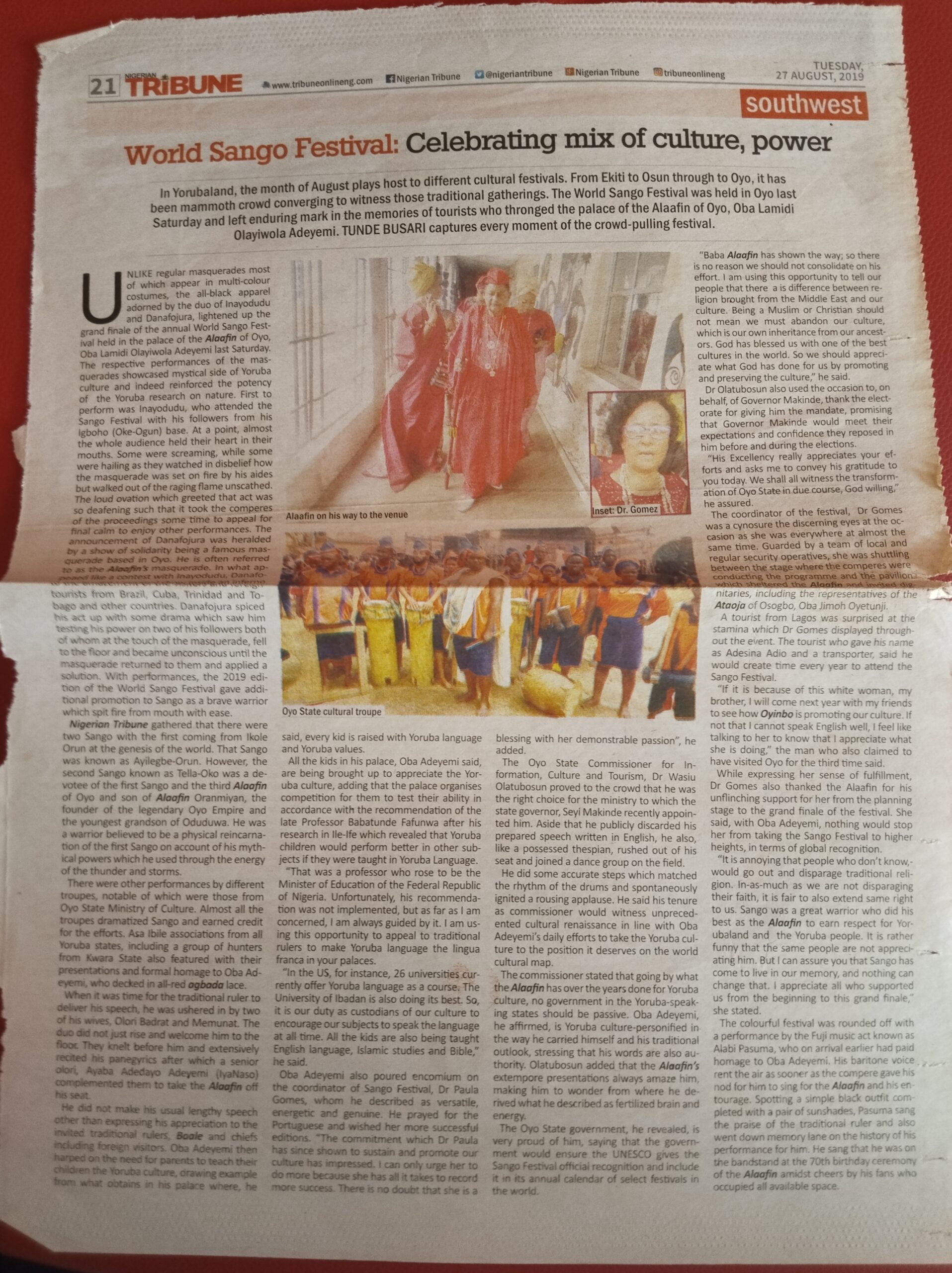
Sunday Tribune, 22 June 2014
Says it’s an International FestivalTHE federal government, through the Ministry of Culture and National Orientation, has expressed the need to endorse the World Sango Festival after what was communicated to it by the Government of Brazil as regards the desire expressed by a majority of Brazilians, particularly the state of Bahia. These Yoruba race attended the maiden edition of the festival in Oyo last year.
The endorsement letter read in parts, the Government, having satisfied itself of the great heritage in the festival, which is geared towards the preservation of our culture will have no doubts adopting and endorsing the World Sango Festival.
Speaking about the festival, the media consultant, the executive Chairman of Logica Media Group Biodun Ajiboye, said he met with the Director General of Nigeria Tourism Development Corporation, Mrs Sally Mbanefo, and she really appreciated the heritage of this culture.
She was said to have given her support and equally her corporate endorsement for the festival which takes place August 21st to 3oth of 2014 at the palace ground.
GOVERNMENT BACKS OYO AS UNESCO SITE
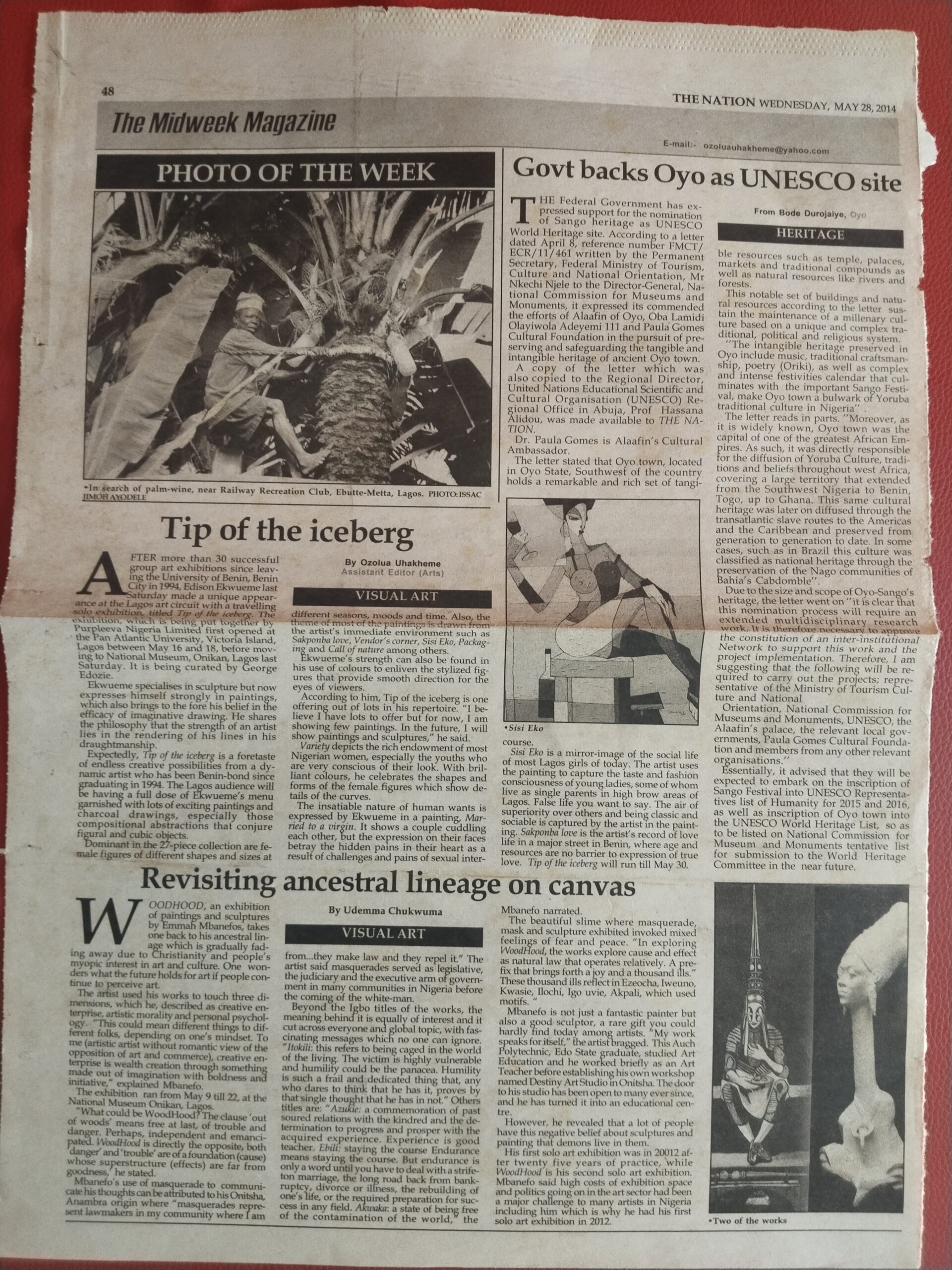
The Federal Government has expressed support for the nomination of Sango heritage as UNESCO World site. According to a letter dated April 8, reference number FMCT/ECR/11/461 written by the Permanent Secretary, Federal Ministry of Tourism, Culture and National Orientation, Mr. Nkechi Njele to the Director¬-General, National Commission for Museums and Monuments it expressed and commended the efforts of Alaafin of Oyo, Oba Lamidi Olayiwola Adeyemi III and Paula Gomes Cultural Foundation in the pursuit of preserving and safeguarding the tangible and intangible heritage of ancient Oyo town.
Orientation, National Commission for Museum and Monuments, UNESCO, the Alaafin’s palace, the relevant local governments, Paula Gomes Cultural Foundation and members from any other relevant organizations’’.
Essentially, it advised that they will be expected to embark on the inscription of Sango Festival into UNESCO Representatives list of Humanity for 2015 and 2016, as well as inscription of Oyo town into the UNESCO World Heritage List, so as to be listed on National Commission for Museum and Monuments tentative list for submission to the World Heritage Committee in the near future.
IMMORTALIZING SANGO’S LEGACY
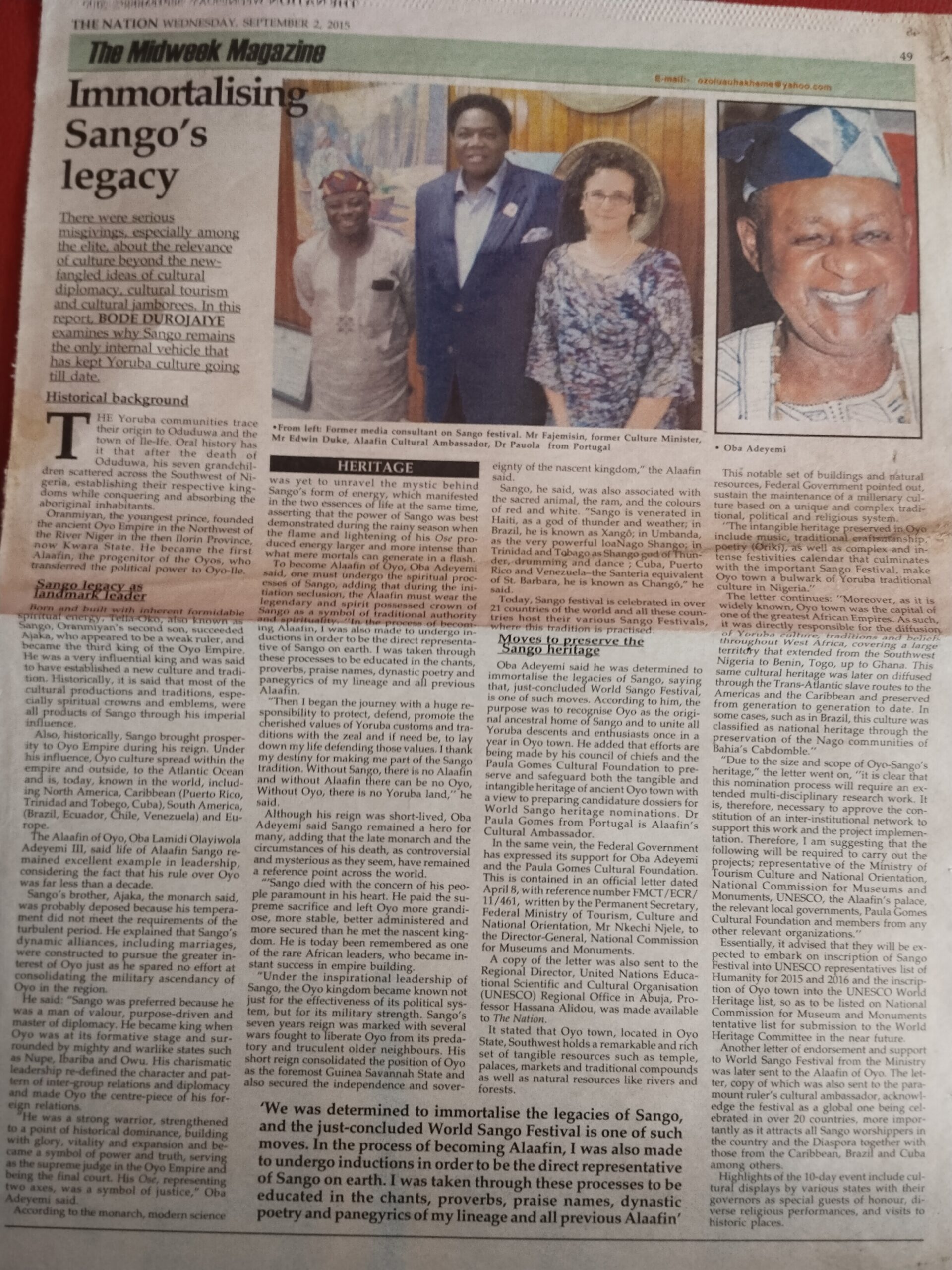
There were serious misgivings, especially among the elite, about the relevance of culture beyond the new- fangled ideas of cultural diplomacy, cultural tourism and cultural jamborees. In this
report BODE DUROJAIYE examines why Sango remains the only internal vehicle that has kept Yoruba culture going till date. Historical background The Yoruba communities trace their origin to Oduduwa and the town of Ile-Ife. Oral history has it that after the death of Oduduwa, his seven grandchildren scattered across the Southwest of Nigeria, establishing their respective kingdom while conquering aboriginal inhabitants.Sango legacy as landmark leader
Born and built with inherent formidable spiritual energy, Tella-Oko, also known as Sango, Oranmiyan’s second son, succeeded Ajaka, who appeared to be a weak ruler, and became the third king of the Oyo Empire. He was a very influential king and was said to have established a new culture and tradition. Historically, it is said that most of the cultural productions and traditions, especially spiritual crowns and emblems, were all products of Sango through his imperial influence.
was far less than a decade.
“He was a strong warrior, strengthened to a point of historical dominance, building with glory, vitality and expansion and became a symbol of power and truth, serving as the supreme judge in the Oyo Empire and being the final court. His Ose, representing two axes, was a symbol of justice,” Oba Adeyemi said.
“Then I began the journey with a huge responsibility to protect, defend, promote the cherished values of Yoruba customs and traditions with the zeal and if need be, to lay down my life defending those values. I thank my destiny for making me part of the Sango tradition. Without Sango, there is no Alaafin and without Alaafin there can be no Oyo, Without Oyo, there is no Yoruba land,” he
said.
also secured the independence and sovereignty of the nascent kingdom, “the Alaafin said.
Moves to preserve the Sango Heritage
projects; representative of the Ministry of Tourism Culture and National Orientation, National Commission for Museums and Monuments, UNESCO, the Alaafin’s palace, the relevant local governments, Paula Gomes Cultural Foundation and members from any other relevant organizations.”
It’s better Yoruba value their Culture now-Dr Gomes
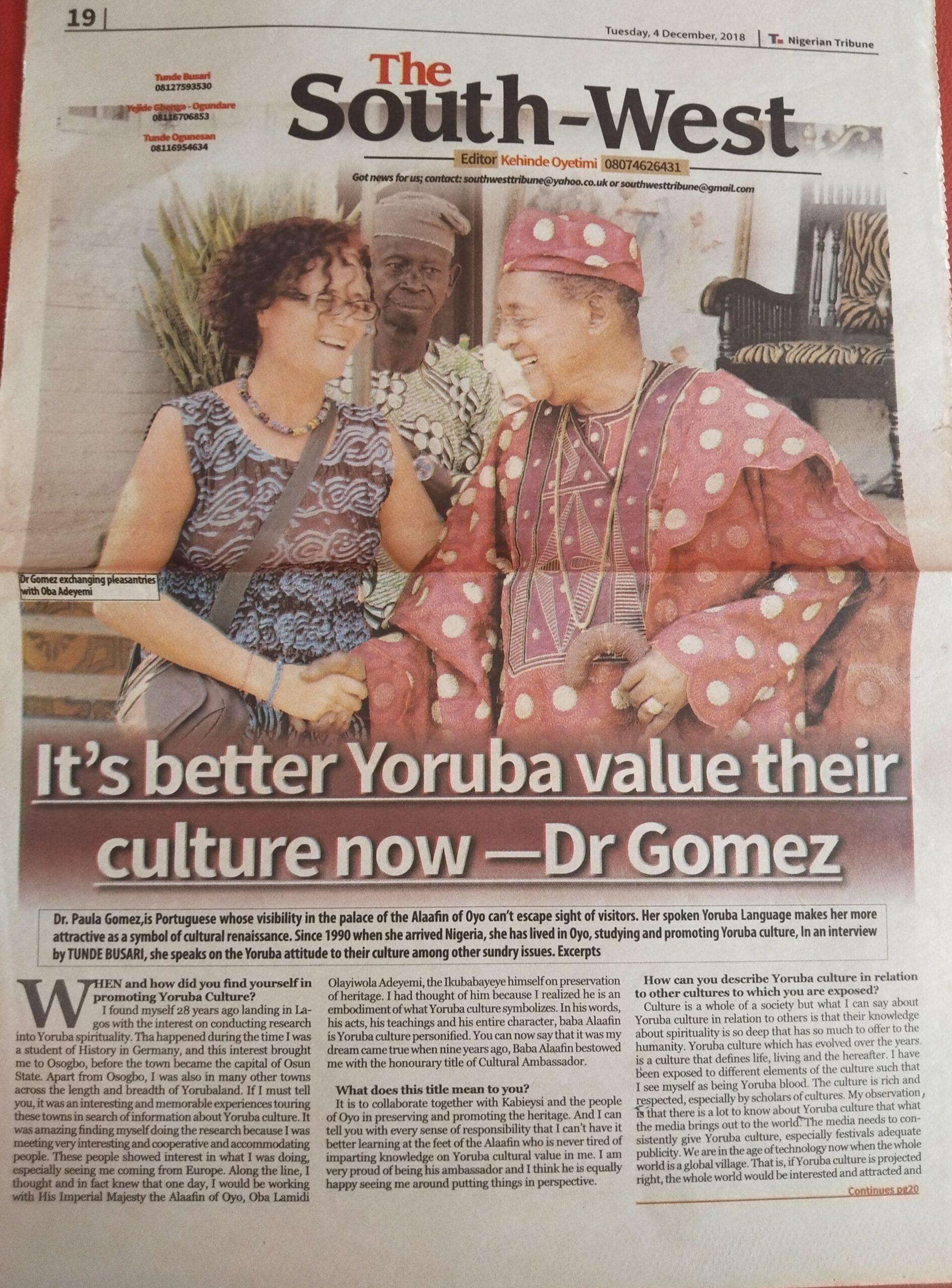
Tuesday, 4 December, 2018, Nigerian Tribune.
Dr. Paula Gomes, is Portuguese whose visibility in the palace of the Alaafin of Oyo can’t escape sight of visitors. Her spoken Yoruba Language makes her more attractive as a symbol of cultural renaissance. Since 1990 when she arrived Nigeria, she has lived in Oyo, studying and promoting Yoruba culture, In an interview by TUNDE BUSARI, she speaks on the Yoruba attitude to their culture among other sundry issues. Excerpts
When and how did you find yourself in promoting Yoruba Culture?
I found myself 28 years ago landing in Lagos with the interest on conducting research into Yoruba spirituality. That happened during the time I was a student of History in Germany, and this interest brought me to Osogbo, before the town became the capital of Osun State. Apart from Osogbo, I was also in many other towns across the length and breadth of Yorubaland. If I must tell you, it was an interesting and memorable experience touring these towns in search of information about Yoruba culture. It was amazing finding myself doing the research because I was meeting very interesting and cooperative and accommodating people. These people showed interest in what I was doing, especially seeing me coming from Europe. Along the line, I thought and in fact knew that one day, I would be working with His Imperial Majesty the Alaafin of Oyo, Oba Lamidi Olayiwola Adeyemi, the Iku Baba Yeye himself on preservation of heritage. I had thought of him because I realized he is an embodiment of what Yoruba culture symbolizes. In his words, his acts, his teachings and his entire character, baba Alaafin is Yoruba culture personified. You can now say that it was my dream came true when nine years ago; Baba Alaafin bestowed me with the honourary title of Cultural Ambassador.
What does this title mean to you?
It is to collaborate together with Kabiyesi and the people of Oyo in preserving and promoting the heritage. And I can better learn at the feet of the Alaafin who is never tired of telling you with every sense of responsibility that I can’t have it imparting knowledge on Yoruba cultural value in me. I am
very proud of being his ambassador and I think he is equally happy seeing me around putting things in perspective.
How can you describe Yoruba culture in relation to other cultures to which you are exposed?
Culture is a whole of a society but what I can say about Yoruba culture in relation to others is that their knowledge about spirituality is so deep and that has so much to offer to the humanity. Yoruba culture which has evolved over the years is a culture that defines life, living and the hereafter. I have been exposed to different elements of the culture such that I see myself as being Yoruba blood. The culture is rich and respected, especially by scholars of cultures. My observation is that there is a lot to know about Yoruba culture than what the media brings out to the world. The media needs to consistently give Yoruba culture, especially festivals adequate publicity. We are in the age of technology now when the whole world is a global village. That is, if Yoruba culture is projected right, the whole world would be interested and attracted and embraced it.
Wasn’t there resistance by your parents and families on your choice of research before you set out to Nigeria?
My parents at the beginning were not convinced about my choice, but with time they accepted and encouraged me. My interest in Yoruba culture and spirituality started with literature from one French Anthropologist called Pierre Verger. I got impressed by his work, and that was the lift up for my journey.
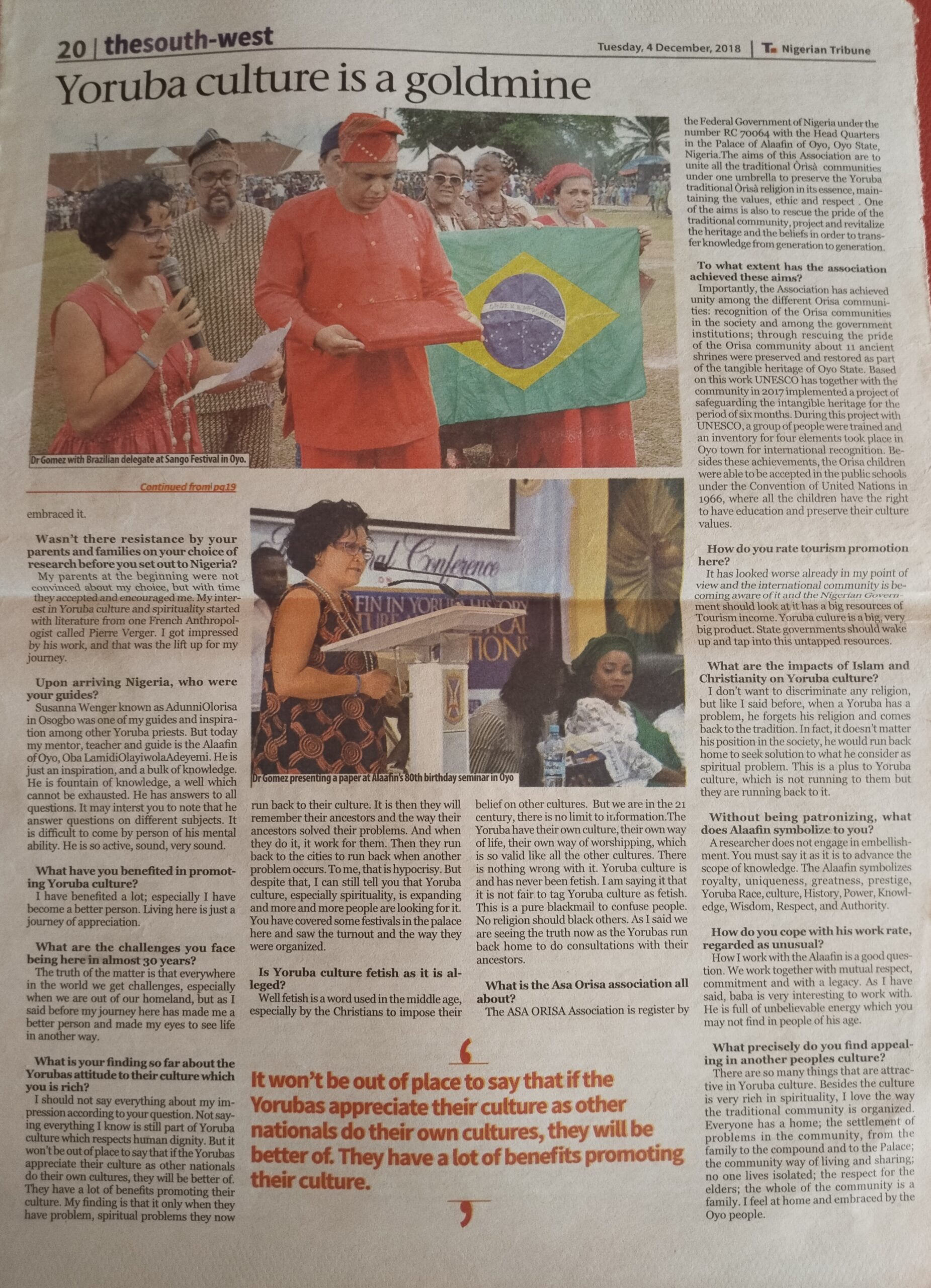
Upon arriving Nigeria, who were your guides?
Susanna Wenger known as Adunni Olorisa in Osogbo was one of my guides and inspiration among other Yoruba priests. But today my mentor, teacher and guide is the Alaafin of Oyo, Oba Lamidi Olayiwola Adeyemi. He is just an inspiration, and a bulk of knowledge. He is a fountain of knowledge, a well which
cannot be exhausted. He has answers to all questions. It may interest you to note that he answer questions on different subjects. It is difficult to come by person of his mental ability. He is so active, sound, very sound.
What have you benefited in promoting Yoruba culture?
I have benefited a lot; especially I have become a better person. Living here is just a journey of appreciation.
What are the challenges you face being here in almost 30 years?
The truth of the matter is that everywhere in the world we get challenges, especially when we are out of our homeland, but as I said before my journey here has made me a better person and made my eyes to see life in another way.
What is your finding so far about the Yoruba attitude to their culture which you is rich?
I should not say everything about my impression according to your question. Not saying everything I know is still part of Yoruba culture which respects human dignity. But it won’t be out of place if Yoruba
appreciate their culture as other nationals do their own cultures, they will be better off. They have a lot of benefits promoting their culture. My finding is that it is only when they have problem, spiritual problems they now run back to their culture. It is then they will remember their ancestors and the way their ancestors solved their problems. And when they do it, it works for them. Then they run back to the cities to run back when another problem occurs. To me, that is hypocrisy. But despite that, I can still tell you that Yoruba culture, especially spirituality, is expanding and more and more people are looking for it. You have covered some festivals in the palace here and saw the turnout and the way they were organized.
Is Yoruba culture fetish as it is alleged?
Well fetish is a word used in the middle age, especially by the Christians to impose their belief on other cultures. But we are in the 21 century; there is no limit to information. The Yoruba have their own culture, their own way of life, their own way of worshipping, which is so valid like all the other cultures. There is nothing wrong with it. Yoruba culture is and has never been fetish. I am saying it that it is not fair to tag Yoruba culture as fetish. This is a pure blackmail to confuse people. No religion should blackmail others. As I said we are seeing the truth now as the Yorubas run back home to do consultations with their ancestors.
What is the Asa Orisa association all about?
The ASA ORISA Association is registered by the Federal Government of Nigeria under the number RC 0064 with the Headquarters in the Palace of The Alaafin of Oyo, Oyo State, Nigeria. The aims of this Association are to unite all the traditional Orisà communities under one umbrella to preserve the Yoruba
traditional Orisà religion in its essence, maintaining the values, ethic and respect. One of the aims is also to rescue the pride of the traditional community, project and revitalize the heritage and the beliefs in order to transfer knowledge from generation to generation.
To what extent has the association achieved these aims?
Importantly, the Association has achieved unity amongst the different Orisa communities: recognition of the Orisa communities in the society and among the government institutions; through rescuing the pride of the Orisa community about 11 ancient shrines were preserved and restored as part of the tangible heritage of Oyo State. Based on this work UNESCO has together with the community in 2017 implemented a project of safeguarding the intangible heritage for the period of six months. During this project with UNESCO, a group of people were trained and an inventory for four elements took place in Oyo town for international recognition. Besides these achievements, the Orisa children were able to be accepted in the public schools under the Convention of United Nations in 1966, where all the children have the right to have education and preserve their cultural values.
How do you rate tourism promotion here?
It has looked worse already in my point of view and the international community is becoming aware of it and the Nigerian Government should look at it has a big resources of Tourism income. Yoruba culture is a big, very big product. State governments should wake up and tap into this untapped resources.
What are the impacts of Islam and Christianity on Yoruba culture?
I don’t want to discriminate any religion, but like I said before, when a Yoruba has a problem, he forgets his religion and comes back to the tradition. In fact, it doesn’t matter his position in the society, he would run back home to seek solution to what he consider as spiritual problem. This is a plus to Yoruba culture, which is not running to them but they are running back to it.
Without being patronizing, what does Alaafin symbolize to you?
A researcher does not engage in embellishment. You must say it as it is to advance the scope of knowledge. The Alaafin symbolizes Royalty, Uniqueness, Greatness, Prestige, Yoruba Race, Culture, History, Power, Knowledge, Wisdom, Respect, and Authority.
How do you cope with his work rate, regarded as unusual?
How I work with the Alaafin is a good question. We work together with mutual respect, commitment and with a legacy. As I have said, baba is very interesting to work with. He is full of unbelievable energy which you may not find in people of his age.
What precisely do you find appealing in another peoples culture?
There are so many things that are attractive in Yoruba culture. Besides the culture is very rich in spirituality, I love the way the traditional community is organized. Everyone has a home; the settlement of problems in the community, from the family to the compound and to the Palace; the community way of living and sharing; no one lives isolated; the respect for the elders; the whole of the community is a family. I feel at home and embraced by the Oyo people.
MAGIC, THUNDER AS TOURIST STORM OYO FOR SANGO FESTIVAL
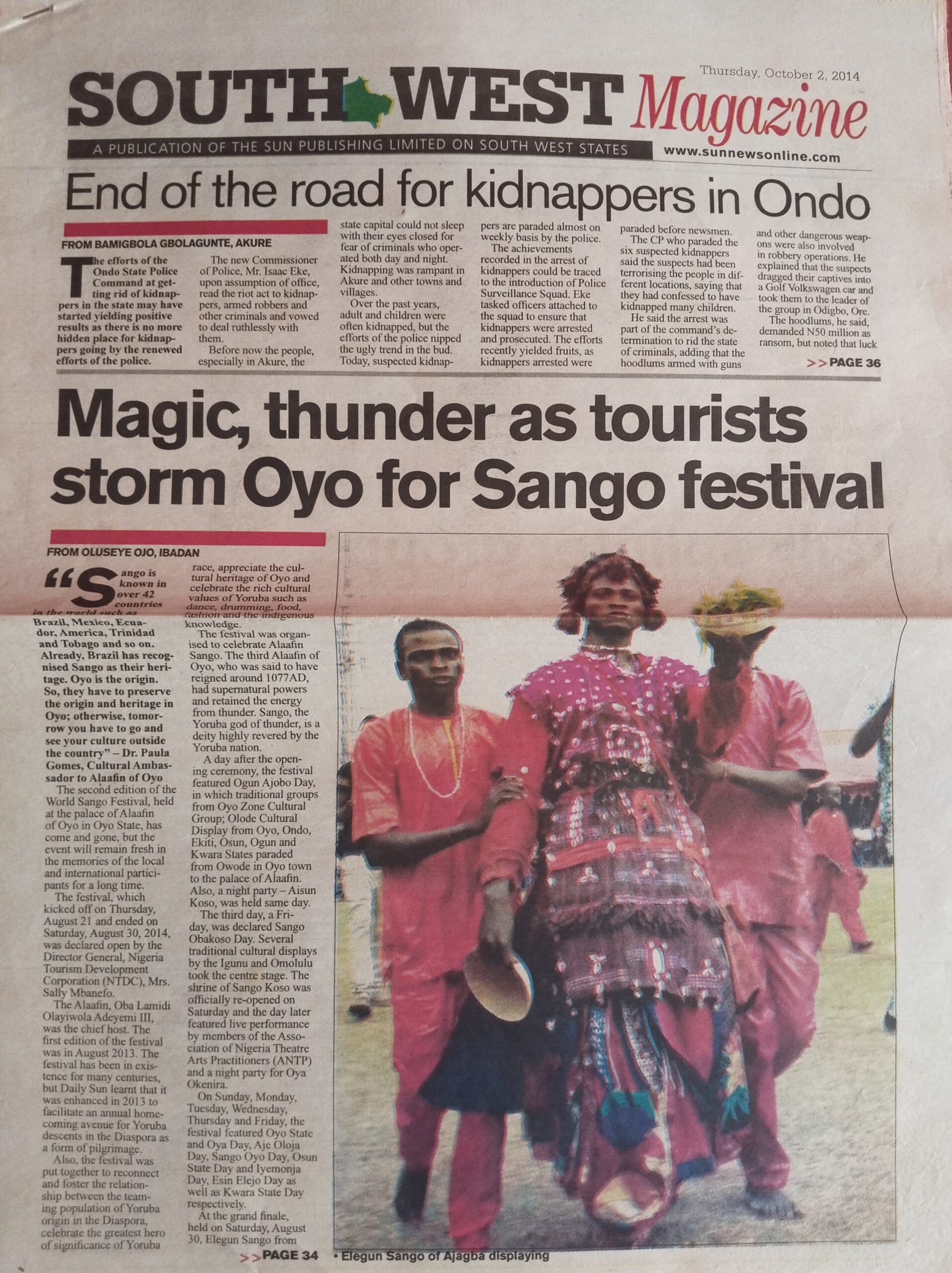
SOUTHWEST MAGAZINE Thursday, October 2, 2014 pg 29
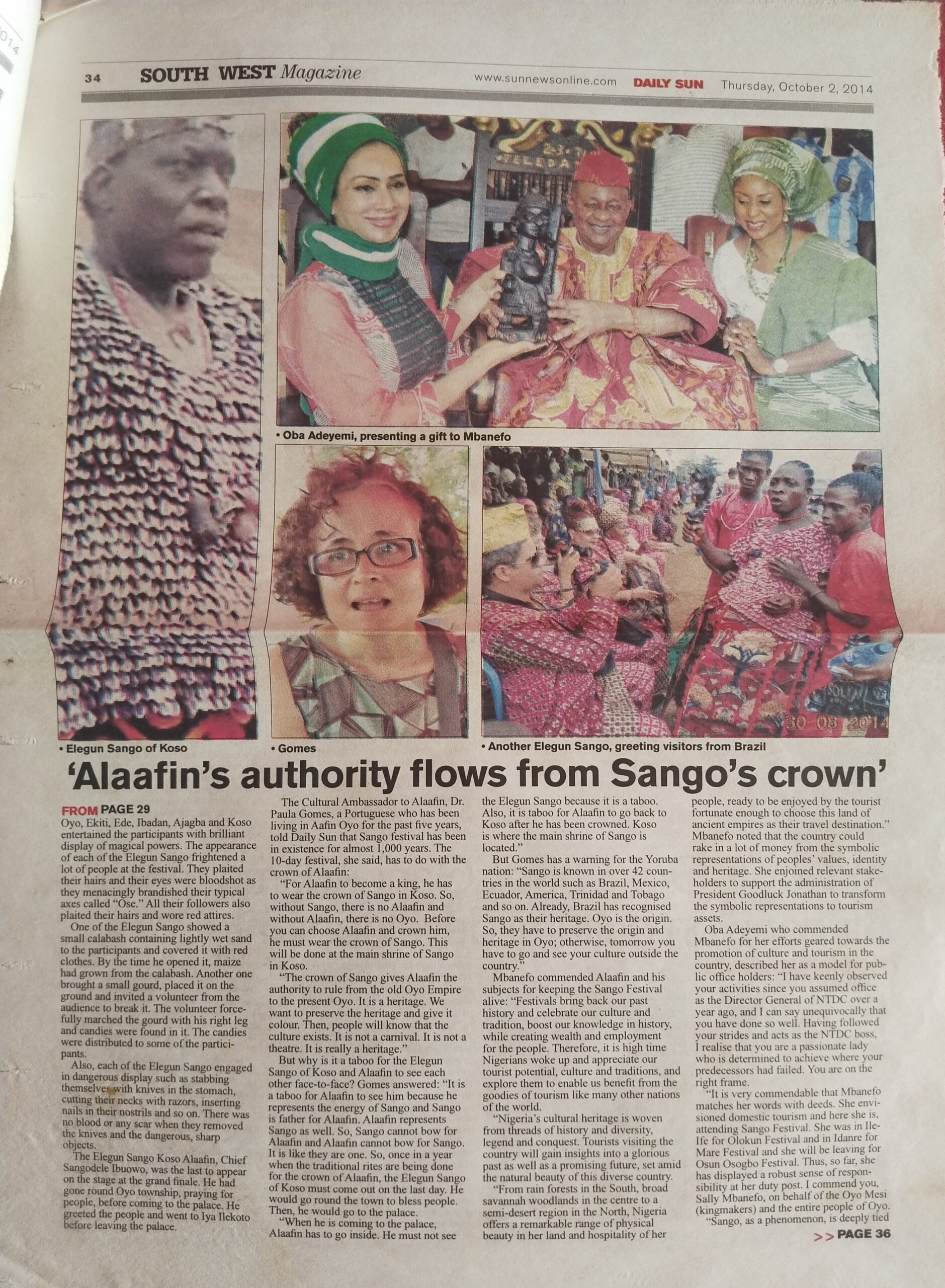
SOUTHWEST MAGAZINE Thursday, October 2, 2014 pg. 34
Magic, thunder as tourist storm Oyo for Sango festival
Sango is known in over 42 countries of the world such as Brazil, Mexico, Ecuador, America, Trinidad and Tobago and so on. Already, Brazil has recognized Sango as their heritage. Oyo is the origin. So, they have to preserve the origin and heritage in Oyo; otherwise, tomorrow you have to go and see your culture outside the country” – Dr. Paula Gomes, Cultural Ambassador to Alaafin of Oyo. The second edition of the World Sango Festival, held at the palace of Alaafin of Oyo in Oyo State, has come and gone, but the event will remain fresh in the memories of the local and international participants for a long time. The festival, which kicked off on Thursday, August 21 and ended on Saturday, August 30, 2014, was declared open by the Director General, Nigeria Tourism Development Corporation (NTDC), Mrs. Sally Mbanefo.
The Alaafin, Oba Lamidi Olayiwola Adeyemi II, was the chief host. The first edition of the festival was in August 2013. The festival has been in existence for many centuries, but Daily Sun learnt that it was enhanced in 2013 to facilitate an annual homecoming avenue for Yoruba descents in the Diaspora as a form of pilgrimage. Also, the festival was put together to reconnect and foster the relationship between the teaming population of Yorubas in the Diaspora, celebrate the greatest hero of significance of Yoruba race, appreciate the cultural heritage of Oyo and celebrate the rich cultural values of Yoruba such as dance, drumming, food, fashion and the indigenous knowledge. The festival was organized to celebrate Alaafin Sango. The third Alaafin of Oyo, who was said to have reigned around 1077AD, had supernatural powers and retained the energy from thunder. Sango, the Yoruba god of thunder, is a deity highly revered by the Yoruba nation.
A day after the opening ceremony, the festival featured Ogun Ajobo Day, in which traditional groups from Oyo Zone Cultural Group; Olode Cultural Display from Oyo, Ondo, Ekiti, Osun, Ogun and Kwara States paraded from Owode in Oyo town to the palace of Alaafin.
Also, a night party –Aisun Koso, was held same day. The third day, a Friday, was declared Sango Oba koso Day. Several traditional cultural displays by the Igunu and Omolulu took the centre stage. The shrine of Sango Koso was officially re-opened on Saturday and the day later featured live performance by members of the Association of Nigeria Theatre Arts Practitioners (ANTP) and a night party for Oya Okenira. On Sunday, Monday, Tuesday, Wednesday, Thursday and Friday, the festival featured Oyo State and Oya Day, Aje Oloja Day, Sango Oyo Day, Osun State Day and Iyemonja Day, Esin Elejo Day as well as Kwara State Day respectively.
At the grand finale, held on Saturday, August 30, Elegun Sango.
Alaafin authority flows from Sango’s crown
Oyo, Ekiti, Ede, Ibadan, Ajagba and Koso entertained the participants with brilliant display of magical powers. The appearance of each of the Elegun Sango frightened a lot of people at the festival. They plaited their hairs and their eyes were bloodshot as they menacingly brandished their typical axes called “Ose.” All their followers also plaited their hairs and wore red attires. One of the Elegun Sango showed a
small calabash containing lightly wet sand to the participants and covered it with red clothes. By the time he opened it, maize had grown from the calabash. Another one brought a small gourd, placed it on the ground and invited a volunteer from the audience to break it. The volunteer forcefully marched the gourd with his right leg and candies were found in it. The candies were distributed to some of the participants.
Also, each of the Elegun Sango engaged in dangerous display such as stabbing themselves with knives in the stomach, cutting their necks with razors, inserting nails in their nostrils and so on. There was no blood or any scar when they removed the knives and the dangerous, sharp objects.
The Elegun Sango Koso Alaafin, Chief Sangodele lbuowo, was the last to appear on the stage at the grand finale. He had gone round Oyo township, praying for people, before coming to the palace. He greeted the people and went to lya Ilekoto before leaving the palace. The Cultural Ambassador to Alaafin, Dr. Paula Gomes, a Portuguese who has been living in Aafin Oyo for the past five years, told Daily Sun that Sango festival has been in existence for almost 1,000 years. The 10-day festival, she said, has to do with the crown of Alaafin.
For Alaafin to become a king, he has to wear the crown of Sango in Koso. So, without Sango, there is no Alaafin and without Alaafin, there is no Oyo. Before you can choose Alaafin and crown him, he must wear the crown of Sango. This will be done at the main shrine of Sango in Koso.
The crown of Sango gives Alaafin the authority to rule from the old Oyo Empire to the present Oyo. It is a heritage. We want to preserve the heritage and give it color. Then, people will know that the culture exists. It is not a carnival. It is not a theatre. It is really a heritage.”
But why is it a taboo for the Elegun Sango of Koso and Alaafin to see each other face-to-face? Gomes answered: “It is a taboo for Alaafin to see him because he represents the energy of Sango and Sango is father for Alaafin. Alaafin represents Sango as well. So, Sango cannot bow for Alaafin and Alaafin cannot bow for Sango. It is like they are one. So, once in a year when the traditional rites are being done for the crown of Alaafin, the Elegun Sango of Koso must come out on the last day. He would go round the town to bless people. Then, he would go to the palace “When he is coming to the palace, Alaafin has to go inside, and He must not see the Elegun Sango because it is a taboo. Also, it is taboo for Alaafin to go back to Koso after he has been crowned. Koso is where the main shrine of Sango is located.
But Gomes has a warning for the Yoruba nation: Sango is known in over 42 countries in the world such as Brazil, Mexico, Ecuador, America, Trinidad and Tobago and so on. Already, Brazil has recognized Sango as their heritage. Oyo is the origin. So, they have to preserve the origin and heritage in Oyo; otherwise, tomorrow you have to go and see your culture outside the country.
Mbanefo commended Alaafin and his subjects for keeping the Sango Festival alive: Festivals bring back our past history and celebrate our culture and tradition, boost our knowledge in history, while creating wealth and employment for the people. Therefore, it is high time Nigerians woke up and appreciate our tourist potential, culture and traditions, and explore them to enable us benefit from the goodies of tourism like many other nations of the world.
Nigeria’s cultural heritage is woven from threads of history and diversity, legend and conquest. Tourists visiting the country will gain insights into a glorious past as well as a promising future, set amid the natural beauty of this diverse country.
From rain forests in the South, broad savannah woodlands in the centre to a semi-desert region in the North, Nigeria offers a remarkable range of physical beauty in her land and hospitality of her people, ready to be enjoyed by the tourist fortunate enough to choose this land of ancient empires as their travel destination.” Mbanefo noted that the country could rake in a lot of money from the symbolic representations of peoples’ values, identity and heritage. She enjoined relevant stakeholders to support the administration of President Goodluck Jonathan to transform the symbolic representations to tourism assets.
Oba Adeyemi who commended Mbanefo for her efforts geared towards the promotion of culture and tourism in the country, described her as a model for public office holders: “I have keenly observed your activities since you assumed office as the Director General of NTDC over a year ago, and I can say unequivocally that you have done so well. Having followed your strides and acts as the NTDC boss, I realize that you are a passionate lady who is determined to achieve where your predecessors had failed. You are on the right frame.
It is very commendable that Mbanefo matches her words with deeds. She envisioned domestic tourism and here she is, attending Sango Festival. She was in lle-Ife for Olokun Festival and in Idanre for Mare Festival and she will be leaving for Osun Osogbo Festival. Thus, so far, she has displayed a robust sense of responsibility at her duty post. I commend you, Sally Mbanefo, on behalf of the Oyo Mesi (kingmakers) and the entire people of Oyo.
Sango, as a phenomenon, is deeply tied to the cultural survival of identity of the Yoruba people. Today, the World Sango festival is a cultural festival that seeks to harness and cement the global popularity of Sango and other Orisas (idols) that are connected to Sango in Yorubaland and around the globe.
Why we celebrate Sango
“Alaafin Sango, the third Alaafin of Oyo, till today is a principal factor in the creation and expansion of Oyo Empire as well as survival and diffusion of the rich cultural values that are now widespread across the world. He reigned around 1077AD and through his ingénue supernatural powers inherently imbued in him, Oyo Empire became one of the most formidable empires in the forest of West African coast; spreading the culture of Oyo far from the boundaries as the empire stretched from South-West Nigeria through Benin Republic, Togo into Ashanti in Ghana.
“Apart from these political achievements, Alaafin Sango’s spiritual crown
has been the only traditional crown for all Alaafin, which instills in them traditional power and authority to head the Yorubaland both politically and spiritually.”
But what does Alaafin love most about Sango? He answered: “My subjects will
greet me Kabiyesi.”
This means who dares challenge thy authority. This is what I love most about Sango. Who dares challenge him? To the best of my knowledge, the only internal vehicle that has kept Yoruba culture till today is Sango.
To become Alaafin of Oyo, the custodian of Yoruba culture and tradition, one must undergo spiritual processes of Sango and after all, wear Sango’s crown as a symbol of authority and spirituality. All these till date confer on all Alaafin the energy of Sango. So, by virtue of Orisa, a descendant of Sango is preserving the heritage of Sango till today.”
The king is the custodian of culture. So, with this festival, the Yoruba culture and tradition will not go into extinction. God created Sango a human being, but He, God, gave him extraordinary powers; the powers are both corrective and destructive.
If somebody steals, Sango will find the person out and punish him or her with death. Also, if you pray to Sango to give you wealth, wife and children, he will give them to you like other idols.”
Chief Oke Adejare Adisa is the Chairman, Asa Orisa Cultural Association to the Alaafin Oyo. He said the festival has been in existence before he was born and that it was a thing of joy to him that Sango is being worshipped in 42 countries.
The international recognition for Sango, according to him, necessitated the reason for the enhancement of Sango festival to the World Sango Festival to let the world know that Oyo is the Origin of Sango: “Sango was Alaafin in Oyo Ile. We have been promoting the festival so that our culture and tradition will not die. Yoruba is the only language that we can use to worship Sango. One of the participants from Brazil, Yia Lucia Omidewa, told Daily Sun that she was excited to be part of this year’s festival, saying her experience at the annual programme was unprecedented. She promised that she would also come for the World Sango Festival in 2015.
MY LIFE AS ALAAFIN’S CULTURAL AMBASSADOR. – PAULA GOMES
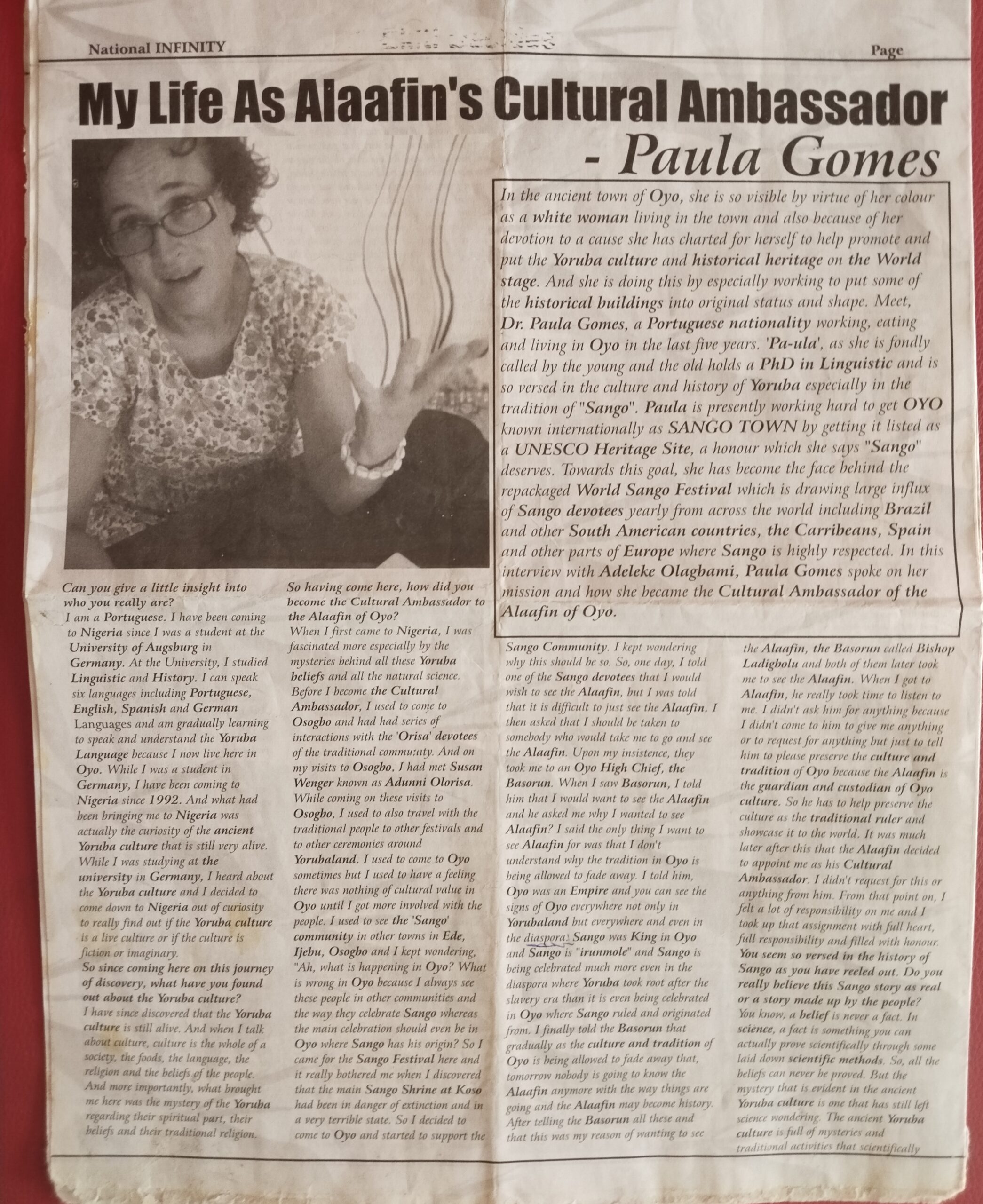
National INFINITY
In the ancient town of Oyo, she is so visible by virtue of her color as a white woman living in the town and also because of her devotion to a cause she has charted for herself to help promote and put the Yoruba Culture and historical heritage on the World stage. And she is doing this by especially working to put some of the historical buildings into original status and shape. Meet, Dr. Paula Gomes, a Portuguese nationality working, eating and living in Oyo in the last five years. ‘pa-ula’, as she is fondly called by the young and old hold a PhD in Linguistics and is so versed in the culture and history of Yoruba especially in the tradition of ‘’Sango’’. Paula is presently working hard to get OYO known internationally as SANGO TOWN by getting it listed as a UNESCO Heritage Site, a honour which she says ‘’Sango’’ deserves. Towards this goal, she has become the face behind repackaged World Sango Festival which is drawing large influx of Sango devotees yearly from across the world including Brazil and other South American Countries, the Carribeans, Spain and other parts of Europe where Sango is highly respected. In this interview with Adeleke Olagbami, Paula Gomes spoke on her mission and how she became the Cultural Ambassador of the Alaafin of Oyo.
Can you give us a little insight into who you are?
I am a Portuguese. I have been coming to Nigeria since I was a student at the University of Augsburg in Germany. At the University, I studied Linguistics and History. I can speak six languages including Portuguese, English, Spanish, and German Languages and am gradually learning to speak and understand the Yoruba Language because I now live here in Oyo. While I was a student in Germany, I have been coming to Nigeria since 1992. And what had been bringing me to Nigeria was actually the curiosity of the ancient Yoruba culture that is still very alive. While I was studying at the University in Germany, I heard about the Yoruba Culture and I decided to come down to Nigeria out of curiosity to really find out if the Yoruba Culture is a live culture or if the culture is fiction or imaginary.
So since coming here on this journey of discovery, what have you found out about the Yoruba Culture?
I have since discovered that the Yoruba culture is still alive. And when I talk about culture, culture is the whole of a society, the foods, the language, the religion and the beliefs of the people. And more importantly, what brought me here was the mystery of the Yoruba regarding their spiritual part, their beliefs and their traditional religion.
So having come here, how did you become the Cultural Ambassador to the Alaafin of Oyo?
When I first came to Nigeria, I was fascinated more especially by the mysteries behind all these Yoruba beliefs and all the natural science. Before I become the Cultural Ambassador, I used to come to Osogbo and had had series of interactions with the Orisa devotees of the traditional community. And on my visits to Osogbo, I had met Susan Wenger known as Adunni Olorisa. While coming on these visits to Osogbo, I used to also travel with the traditional people to other festivals and to other ceremonies around Yoruba land. I used to come to Oyo sometimes but I used to have a feeling there was nothing of cultural value in Oyo until I got more involved with the people. I used to see the Sango Community in other towns in Ede, Ijebu, Osogbo and I kept wondering, ah, what is happening in Oyo? What is wrong in Oyo because I always see these people in other communities and the way they celebrate Sango whereas the main celebration should even be in Oyo where Sango has his own origin. So I came for the Sango festival here and it really bothered me when I discovered that the main Sango Shrine at Koso had been in danger of extinction and in a very terrible state. So I decided to come to Oyo and started to support the Sango Community. I kept wondering why this should be so, one day, I told one of the Sango devotees that I would wish to see the Alaafin, but I was told that it is difficult to just see the Alaafin. I then asked that I should be taken to somebody who would take me to go and see the Alaafin. Upon my insistence, they took me to an Oyo High Chief, the Basorun. When I saw Basorun, I told him that I would want to see the Alaafin and he asked me why I wanted to see the Alaafin? I said the only things I want to see the Alaafin for was that I don’t understand why the tradition in Oyo is being allowed to fade away. I told him, Oyo was an Empire and you can see the signs of Oyo everywhere not only in Yorubaland but everywhere and even in the Diaspora. Sango was king in Oyo and Sango is irunmole and Sango is being celebrated much more even in the Diaspora where Yoruba took root after the slavery era than it is even being celebrated in Oyo where Sango ruled and originated from. I finally told Basorun that gradually as the culture and tradition of Oyo is being allowed to fade away that tomorrow nobody is going to know the Alaafin anymore with the way things are going and the Alaafin may become history. After telling Basorun all these and that this was my reason of wanting to see the Alaafin, the Basorun called Bishop Ladigbolu and both of them later took me to see the Alaafin. When I got to Alaafin he really took time to listen to me. I didn’t ask him for anything because I didn’t come to him to give me anything or request for anything but just to tell him to please preserve the culture and tradition of Oyo because the Alaafin is the guardian and custodian of Oyo culture. So he has to help preserve the culture as the traditional ruler and showcase it to the world. It was much later after this that the Alaafin decided to appoint me as his Cultural Ambassador. I didn’t request for this or anything from him. From that point on, I felt a lot of responsibility on me and I took up that assignment with full heart, full responsibility and filled with honour.
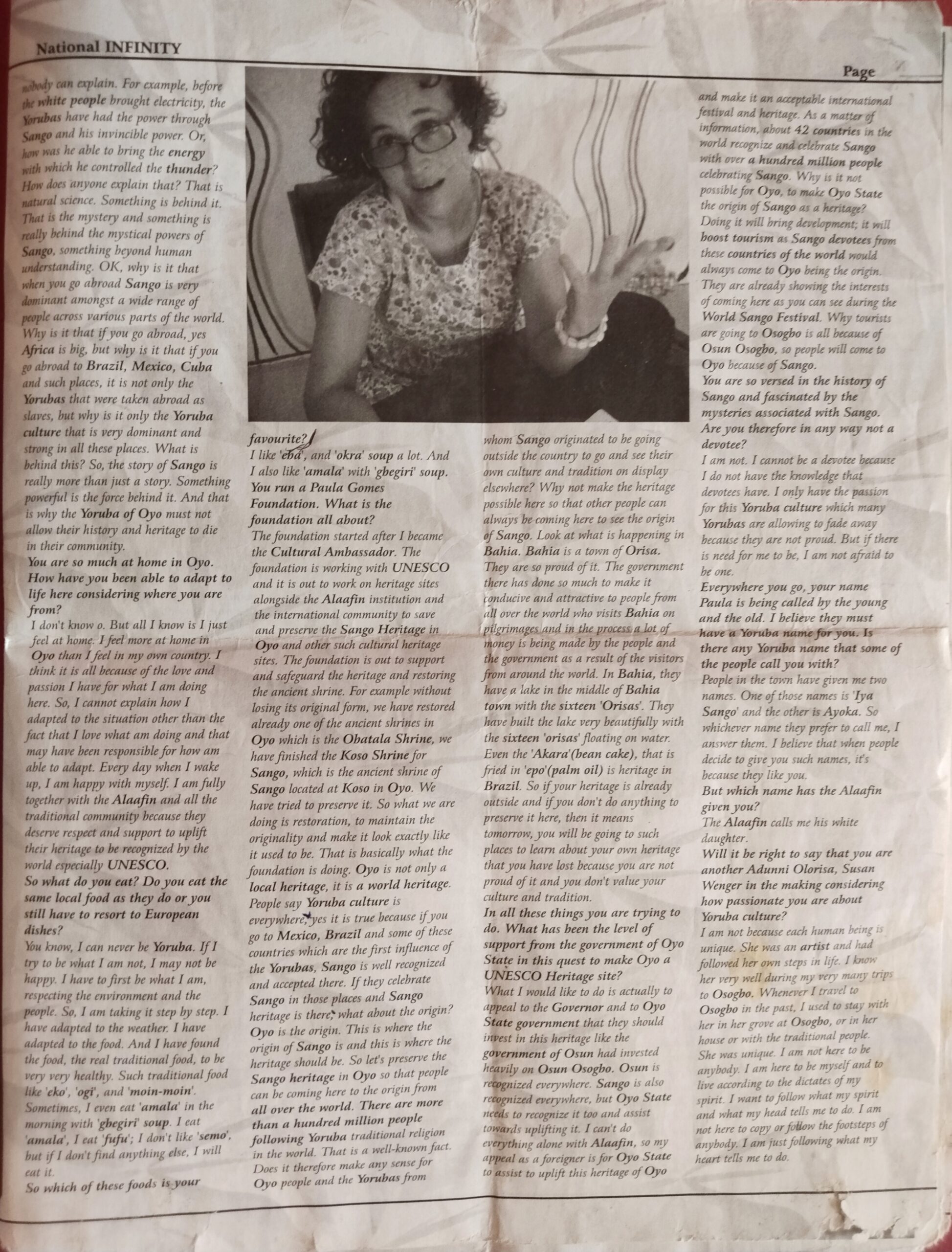
You seem so versed in the history of Sango as you have reeled out. Do you really believe this Sango story as real or a story made up by the people?
You know, a belief is never a fact. In science, a fact is something you can actually prove scientifically through some laid down scientific methods. So, all the beliefs can never be proved. But the mystery that is evident in the ancient Yoruba culture is one that has still left science wondering. The ancient Yoruba culture is full of mysteries and traditional activities that scientifically nobody can explain. For example, before the white people brought electricity, the Yorubas have had the power through Sango and his invincible power. Or, how was he able to bring the energy with which he controlled the thunder? How does anyone explain that? That is natural science. Something is really behind it. That is the mystery and something is really behind the mystical powers of Sango, something beyond human understanding. Ok why is it that when you go abroad Sango is very dominant amongst a wide range of people across various parts of the world. Why is it that if you go abroad, yes Africa is big, but why is it that if you go abroad to Brazil, Mexico, Cuba, and such places it is not only Yorubas that were taken abroad as slaves, but why is it only Yoruba culture that is very dominant and strong in all these places. What is behind this? So, the story of Sango is really more than just a story. Something powerful is the force behind it. And that is why the Yoruba of Oyo must not allow their history and heritage to die in their community.
You are so much at home in Oyo. How have you been able to adapt to life here considering where you are from?
I don’t know o. But all I know is I just feel at home. I feel more at home in Oyo than I feel in my own country. I think it is all because of the love and passion I have for what I am doing. So, I cannot explain how I adapted to the situation other than the fact that I love what I am doing and that may have been responsible for how am able to adapt. Every day when I wake up, I am happy with myself. I am fully together with the Alaafin and all the traditional community because they deserve respect and support to uplift their heritage to be recognized by the world especially UNESCO.
So what do you eat? Do you eat the same local food as they do or you still have to resort to European dishes?
You know, I can never be Yoruba. If I try to be what I am not, I may not be happy. I have to first be what I am, respecting the environment and the people. So, I am taking it step by step. I have adapted to the weather, I have adapted to the food. And I have found the food, the real traditional food to be very healthy. Such traditional food like ‘eko’, ‘ogi’, and ‘moi-moi’. Sometimes, I eat ‘fufu’, I don’t like ‘semo’, but if I don’t find anything else, I will eat it.
So which of these is your favorite?
I like eba and okra soup a lot. And I also like amala with gbegiri soup.
You run a Paula Gomes Foundation. What is the Foundation all about?
The foundation started after I become the Cultural Ambassador. The foundation is working with UNESCO and it is out to work on heritage sites alongside the Alaafin institution and the international community to save and preserve the Sango Heritage in Oyo and other such cultural heritage sites. The foundation is out to support and safeguard the heritage and restoring the ancient shrine. For example without losing its original form, we have restored already one of the ancients shrines in Oyo which is the Obatala Shrine, we have finished the Koso Shrine for Sango, which is the ancient shrine for Sango located at Koso in Oyo. We have tried to preserve it. So what we are doing is restoration, to maintain the originality and make it look exactly like it used to be. That is basically what the foundation is doing. Oyo is not only a local heritage, it is a world heritage. People say Yoruba culture is everywhere, yes it is true because if you go to Mexico, Brazil and some of these countries which are the first influence of the Yorubas, Sango is well recognized and accepted there. If they celebrate Sango in those places and Sango
heritage is there, what about the origin? Oyo is the origin. This is where the origin of Sango is and this is where the heritage should be. So let’s preserve the Sango heritage in Oyo so that people can be coming here to the origin from all over the world. There are more than a hundred million people following Yoruba traditional religion in the world. That is a well-known fact. Does it therefore make any sense for Oyo people and the Yorubas from whom Sango originated to be going outside the country to go and see their own culture and tradition on display elsewhere? Why not make the heritage possible here so that other people can always be coming here to see the origin of Sango. Look at what is happening in Bahia. Bahia is a town of Orisa. They are so proud of it. The government there has done so much to make it conducive and attractive to people from all over the world who visits Bahia on pilgrimages and in the process a lot of money is being made by the people and the government as a result of the visitors from around the world. In Bahia, they have a lake in the middle of Bahia town with the sixteen ‘Orisas’. They
have built the lake very beautifully with the sixteen ‘orisas’ floating on Water. Even the Akara’ (bean cake), that is fried in ‘epo’ (palm oil) is heritage in Brazil. So if your heritage is already outside and if you don’t do anything to preserve it here, then it means tomorrow, you will be going to such places to learn about your own heritage that you have lost because you are not proud of it and you don’t value your culture and tradition.
In all these things you are trying to do. What has been the level of support from the government of Oyo State in this quest to make Oyo a UNESCO Heritage site?
What I would like to do is actually to appeal to the Governor and to Oyo State government that they should invest in this heritage like the government of Osun had invested heavily on Osun Osogho, Osun is recognized everywhere Sango is also recognized very where, but Oyo State needs to recognize it too and assist towards uplifting it. I can’t do everything alone with Alaafin, so my appeal as a foreigner is for Oyo State to assist to uplift this heritage of Oyo and make it an acceptable international festival and heritage. As a matter of information, about 42 countries in the world recognize and celebrate Sango with over a hundred million people celebrating Sango. Why is it not possible for Oyo, to make Oyo State the origin of Sango as a heritage? Doing it will bring development; it will boost tourism as Sango devotees from
these countries of the world would always come to Oyo being the origin. They are already showing the interests of coming here as you can see during the World Sango Festival. Why tourists are going to Osogbo is all because of Osun Osogbo, so people will come to Oyo because of Sango.
You are so versed in the history of Sango and fascinated by the mysteries associated with Sango. Are you therefore in any way not a devotee?
I am not. I cannot be a devotee because I do not have the knowledge that devotees have. I only have the passion for this Yoruba culture which many Yoruba’s are allowing to fade away because they are not proud. But if there is need for me to be, I am not afraid to be one.
Everywhere you go, your name Paula is being called by the young and the old. I believe they must have a Yoruba name for you. Is there any Yoruba name that some of the people call you with?
People in the town have given me two names. One of those names is ‘Iya Sango’ and the other is Ayoka. So whichever name they prefer to call me, I answer them. I believe that when people decide to give you such names, it’s because they like you.
But which name has the Alaafin given you?
The Alaafin calls me his white daughter.
Will it be right to say that you are another Adunni Olorisa, Susan Wenger in the making considering how passionate you are about Yoruba culture?
I am not because each human being is unique. She was an artist and had followed her own steps in life. I know her very well during my very many trips to Osogbo, Whenever I travel to Osogbo in the past, I used to stay with her in her grove at Osogbo, or in her house or with the traditional people. She was unique. I am not here to be anybody. l am here to be myself and to live according to the dictates of my spirit. I want to follow what my spirit and what my head tells me to do. I am not here to copy or follow the footsteps of anybody. I am just following what my heart tells me to do.
OYO HOSTS WORLD SANGO FESTIVAL
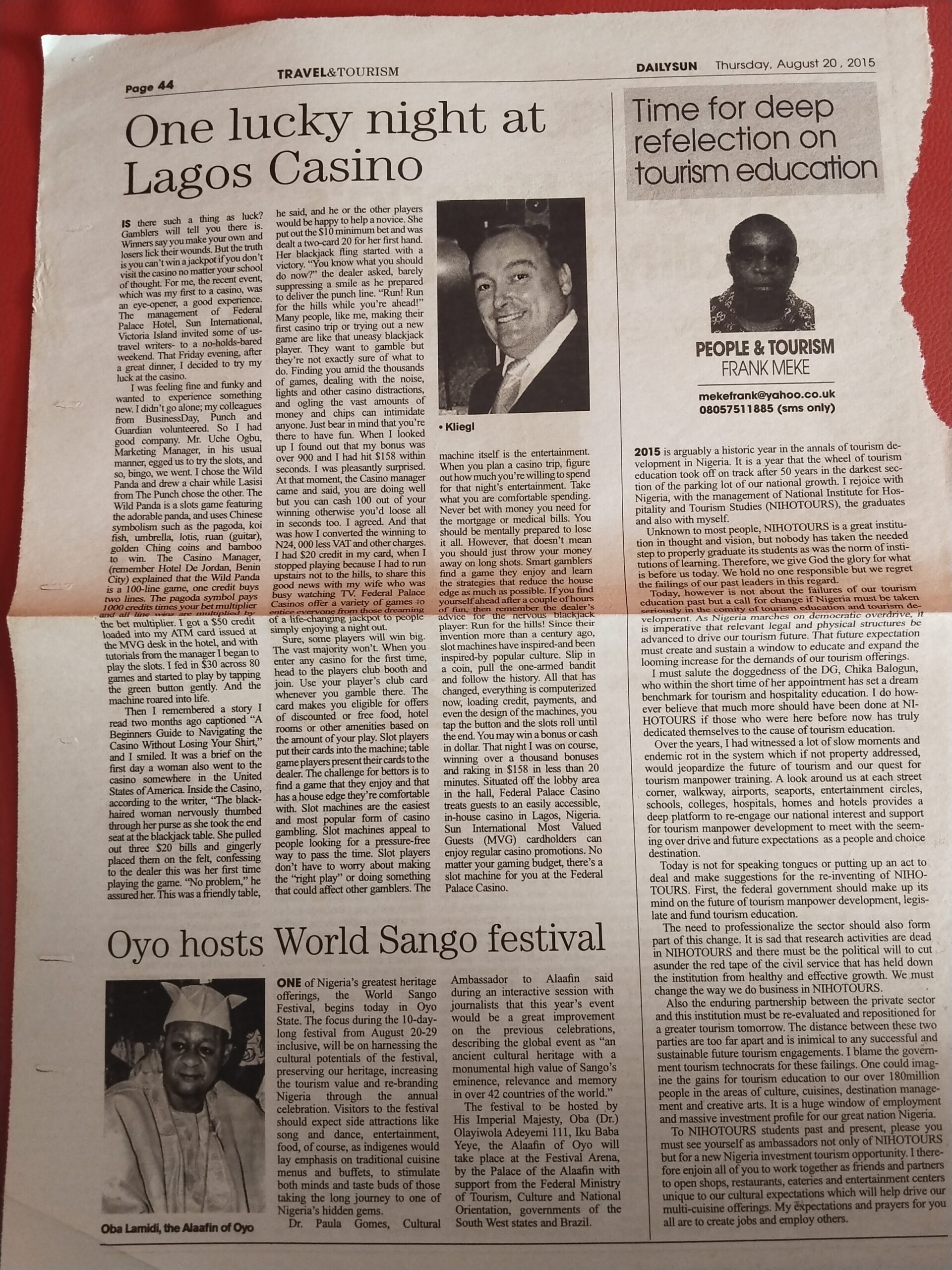
ONE of Nigeria’s greatest heritage offerings, the World Sango Festival, begins today in Oyo State. The focus during the 10-day-long festival from August 20-29 inclusive will be on harnessing the cultural potentials of the festival, preserving our heritage, increasing the tourism value and re-branding Nigeria through the annual celebration. Visitors to the festival should expect side attractions like songs and dances, entertainment, food, of course, as indigenes would lay emphasis on traditional cuisine menus and buffets, to stimulate both minds and taste buds of those taking the long journey to one of Nigeria’s hidden gems.
Dr. Paula Gomes, Cultural Ambassador to Alaafin said during an interactive session with journalists that this year’s event would be a great improvement on the previous celebrations, describing the global event as “an ancient cultural heritage with a monumental high value of Sango’s eminence, relevance and memory in over 42 countries of the world.”
The festival to be hosted by His Imperial Majesty, Oba (Dr.) Olayiwola Adeyemi III, Iku Baba Yeye, the Alaafin of Oyo will take place at the Festival Arena, by the Palace of the Alaafin with support from the Federal Ministry of Tourism, Culture and National Orientation, governments of the South West states and Brazil.
Sango Festival Belongs To the Intangible Heritage –Paula Gomes
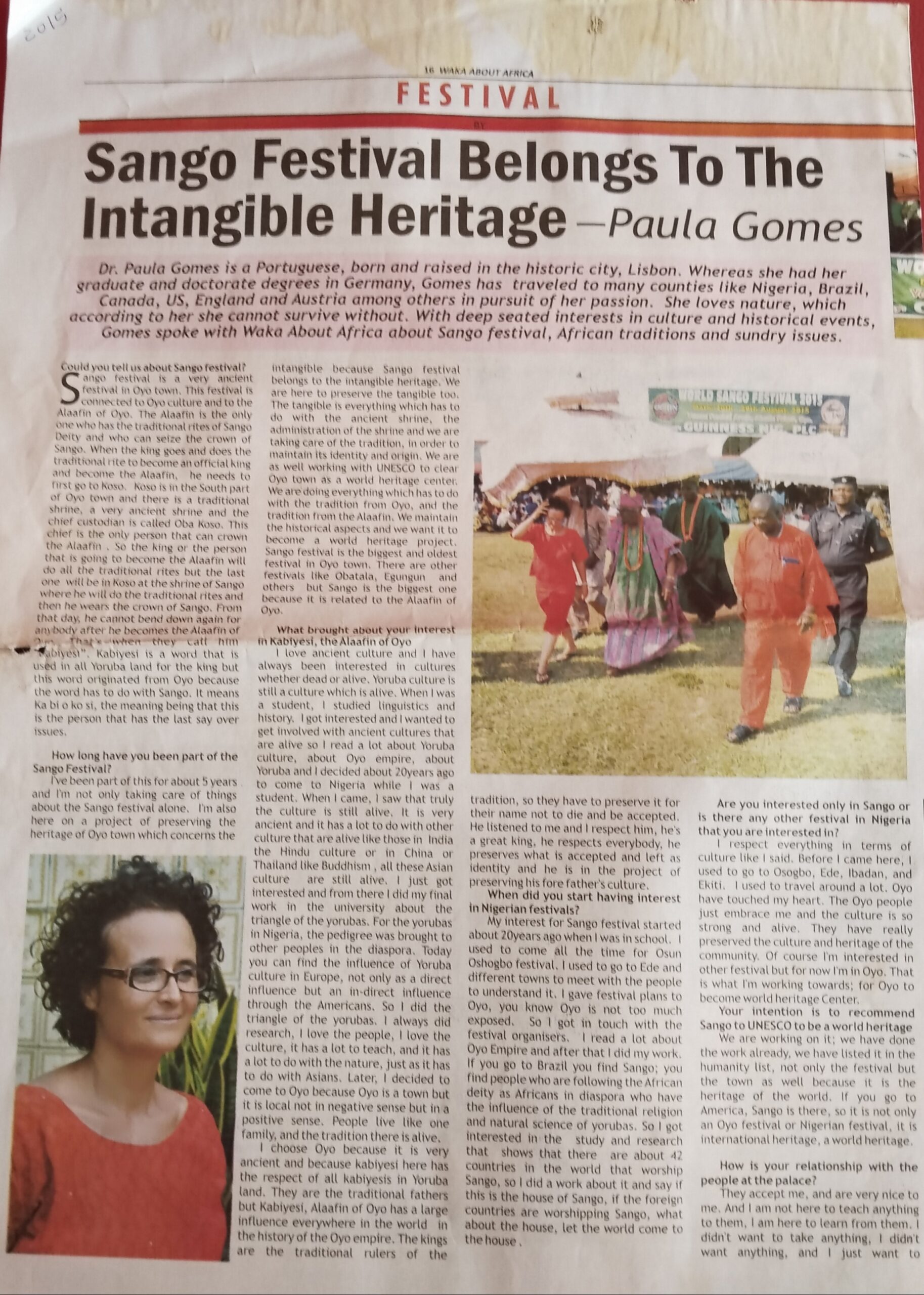
WAKA ABOUT AFRICA PG 16
Dr. Paula Gomes is a Portuguese, born and raised in the historic city, Lisbon. Whereas she had her graduate and doctorate degrees in Germany, Gomes has traveled to many countries like Nigeria, Brazil, Canada, US, England and Australia among others in pursuit of her passion. She loves nature, which according to her cannot survive without. With deep seated interest in culture and historical events, Gomes speak with Waka About Africa, about Sango festival, African traditions and sundry issues.
Could you tell us about Sango festival?
Sango festival is a very ancient festival in Oyo town. This festival is connected to Oyo culture and to the Alaafin of Oyo. The Alaafin is the only one who has the traditional rites of Sango Deity and who can seize the crown of Sango. When the king goes and does the traditional rite to become an official king and become the Alaafin, he needs to first go to Koso. Koso is in the Southern part of Oyo town and there is a traditional shrine, a very ancient shrine and the chief custodian is called Mogba Koso, This chief is the only person that can crown the Alaafin. So the king or the person that is going to become the Alaafin will do all the traditional rites but the last one will be in Koso at the shrine of Sango where he will do the traditional rites and then he wears the crown of Sango. From that day, he cannot bend down again for anybody after he becomes the Alaafin of Oyo. That’s when they call him Kabiyesi”. Kabiyesi is a word that is used in all Yoruba land for the king but this word originated from Oyo because the word has to do with Sango. It means “Ka bi o ko si,” the meaning being that this is the person that has the last say over issues.
How long have you been part of the Sango Festival?
I’ve been part of this for about 5 years and I’m not only taking care of things about the Sango festival alone. I’m also here on a project of preserving the heritage of Oyo town which concerns the intangible because Sango festival belongs to the intangible heritage. We are here to preserve the tangible too. The tangible is everything which has to do with the ancient shrine, the administration of the shrine and we are taking care of the tradition, in order to maintain its identity and origin. We are as well working with UNESCO to clear Oyo town as a world heritage center. We are doing everything which has to do with the tradition from Oyo, and the tradition from the Alaafin. We maintain the historical aspects and we want it to become a world heritage project. Sango festival is the biggest and oldest festival in Oyo town. There are other festivals like Obatala, Egungurn and others but Sango is the biggest one because it is related to the Alaafin of Oyo.
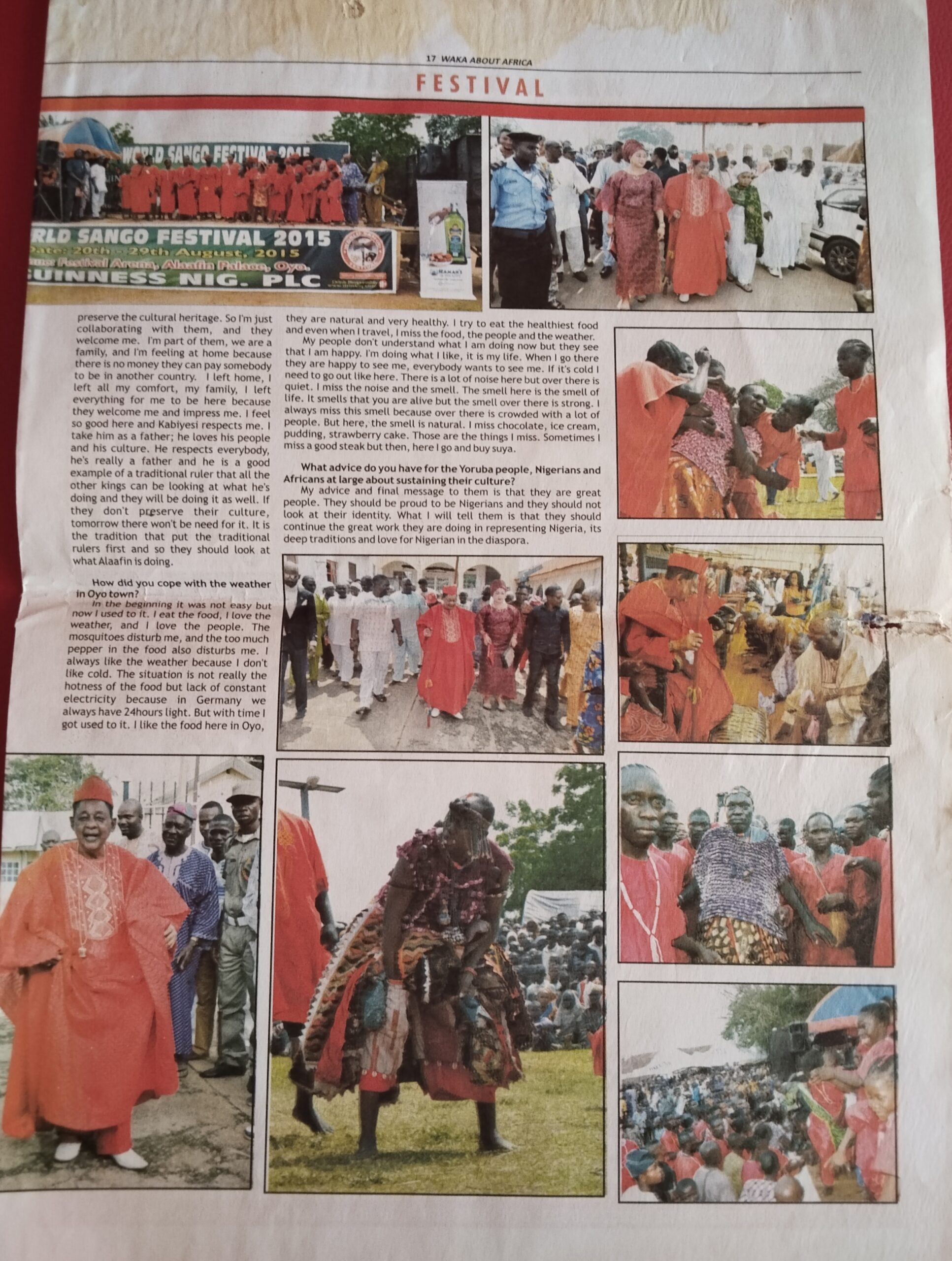
What brought about your interest in Kabiyesi, the Alaafin of Oyo?
I love ancient culture and I have always been interested in cultures whether dead or alive. Yoruba culture is still a culture which is alive. When I was a student, I studied linguistics and history. I got interested and I wanted to get involved with ancient cultures that are alive so I read a lot about Yoruba culture, about Oyo Empire, about Yoruba and I decided about 20years ago to come to Nigeria while I was a student. When I came, I saw that truly the culture is still alive. It is very ancient and it has a lot to do with other culture that are alive like those in India the Hindu culture or in China or Thailand like Buddhism, all these Asian culture are still alive. I just got interested and from there I did my final work in the university about the triangle of the Yorubas. For the Yorubas in Nigeria, the pedigree was brought to other peoples in the Diaspora. Today you can find the influence of Yoruba culture in Europe, not only as a direct influence but an in-direct influence through the Americans. So I did the triangle of the Yorubas. I always did research, I love the people, I love the culture, it has a lot to teach, and it has a lot to do with the nature, just as it has to do with Asians. Later, I decided to come to Oyo because Oyo is a town but it is local not in negative sense but in a positive sense. People live like one family, and the tradition there is alive. I choose Oyo because it is very ancient and because kabiyesi here has the respect of all kabiyesi in Yoruba land. They are the traditional fathers but Kabiyesi, Alaafin of Oyo has a large influence everywhere in the world in the history of the Oyo empire. The kings are the traditional rulers of the tradition, so they have to preserve it for their name not to die and be accepted. He listened to me and I respect him, he’s a great king, he respects everybody, he preserves what is accepted and left as identity and he is in the project of preserving his forefather’s culture.
When did you start having interest in Nigerian festivals?
My interest for Sango festival started about 20years ago when I was in school. I used to come all the time for Osun Oshogbo festival. I used to go to Ede and different towns to meet with the people to understand it. I gave festival plans to Oyo; you know Oyo is not too much exposed. So I got in touch with the festival organizers. I read a lot about Oyo Empire and after that I did my work. If you go to Brazil you find Sango; you find people who are following the African deity as Africans in Diaspora who have the influence of the traditional religion and natural science of Yorubas. So I got interested in the study and research that shows that there are about 42 countries in the world that worship Sango, so I did a work about it and say if this is the house of Sango, if the foreign Countries are worshipping Sango, what about the house, let the world come to the house.
Are you interested only in Sango or is there any other festival in Nigeria that you are interested in?
I respect everything in terms of culture like I said. Before I came here, I used to go to Osogbo, Ede, lbadan, and Ekiti. I used to travel around a lot. Oyo have touched my heart. The Oyo people just embraced me and the culture is so strong and alive. They have really preserved the culture and heritage of the community. Of course I’m interested in other festivals but for now l am in Oyo. That is what I’m working towards; for Oyo to become world heritage Center.
Your intention is to recommend Sango to UNESCO to be a world heritage
We are working on it; we have done the work already, we have listed it in the humanity list, not only the festival but the town as well because it is the heritage of the world. If you go to America, Sango is there, so it is not only an Oyo festival or Nigerian festival, it is international heritage, a world heritage.
How is your relationship with the people at the palace?
They accept me, and are very nice to me. And l am not here to teach anything to them, I am here to learn from them. I didn’t want to take anything, I didn’t want anything, and I just want to preserve the cultural heritage. So I’m just collaborating with them, and they welcome me. I’m part of them, we are a family, and I’m feeling at home because there is no money they can pay somebody to be in another country. I left home, I left all my comfort, my family, I left everything for me to be here because they welcome me and impress me. I feel so good here and Kabiyesi respects me. I take him as a father; he loves his people and his culture. He respects everybody, he’s really a father and he is a good example of a traditional ruler that all the other kings can be looking at what he’s doing and they will be doing it as well. If they don’t preserve their culture, tomorrow there won’t be need for it. It is the tradition that put the traditional rulers first and so they should look at what Alaafin is doing.
How did you cope with the weather in Oyo town?
In the beginning it was not easy but now I am used to it. I eat the food, I love the weather, and I love the people. The mosquitoes disturb me, and the too much pepper in the food also disturbs me. I always like the weather because I don’t like cold. The situation is not really the hotness of the weather but lack of constant electricity because in Germany we always have 24hours light. But with time I got used to it. I like the food here in Oyo, they are natural and very healthy. I try to eat the healthiest food and even when I travel, I miss the food, the people and the weather.
My people don’t understand what I am doing now but they see that I am happy. I am doing what I like, it is my life. When I go there they are happy to see me, everybody wants to see me. If it’s cold I need to go out like here. There is a lot of noise here but over there is quiet. I miss the noise and the smell. The smell here is the smell of life. It smells that you are alive but the smell over there is strong. I always miss this smell because over there is crowded with a lot of people. But here, the smell is natural. I miss chocolate, ice cream, pudding, strawberry cake. Those are the things I miss. Sometimes I miss a good steak but then, here I go and buy suya.
What advice do you have for the Yoruba people, Nigerians and Africans at large about sustaining their culture?
My advice and final message to them is that they are great people. They should be proud to be Nigerians and they should not look at their identity. What I will tell them is that they should continue the great work they are doing in representing Nigeria, its deep traditions and love for Nigerian in the Diaspora.
World’s Floodlights on Sango Festival
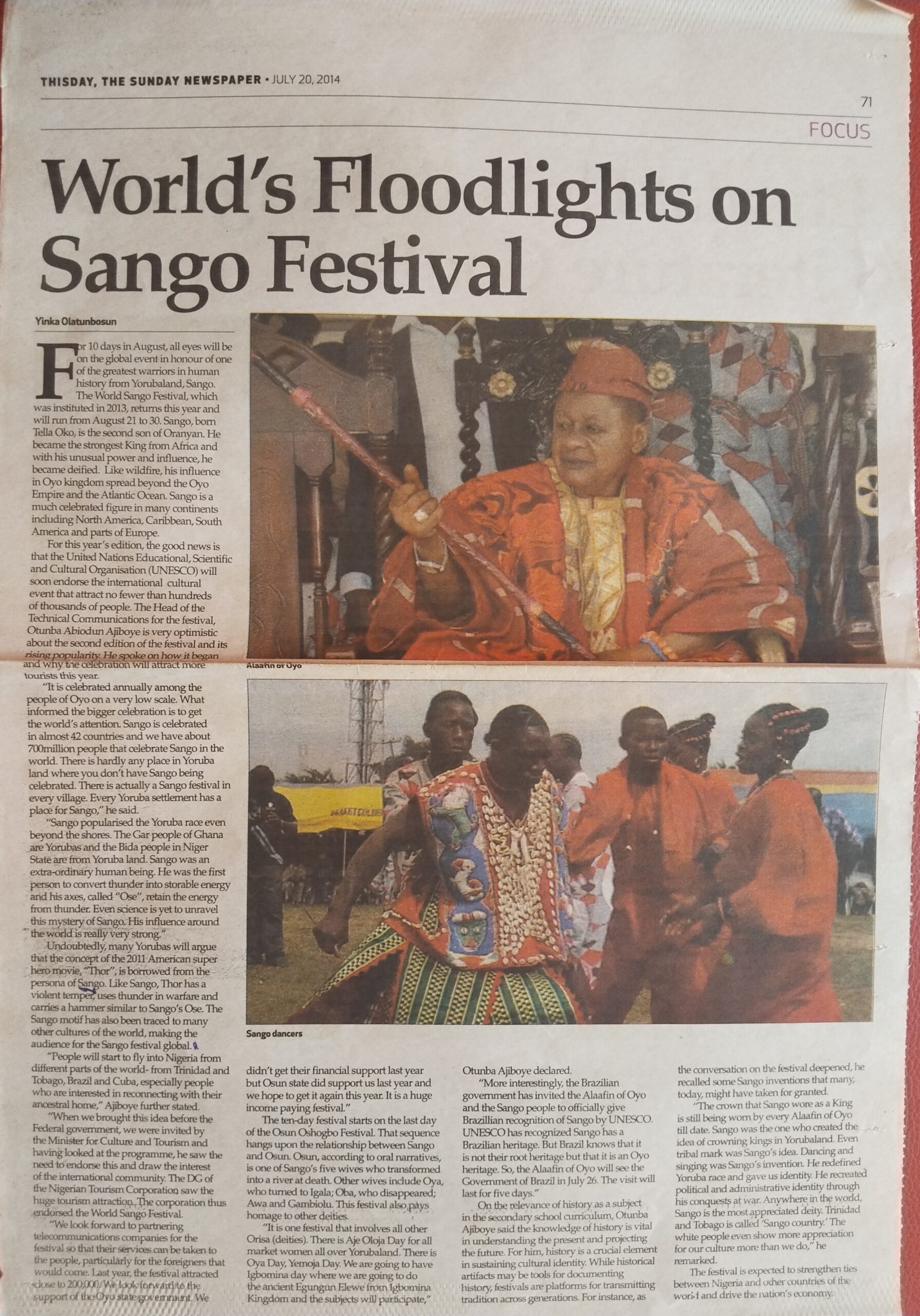
THURSDAY, THE SUNDAY NEWSPAPER JULY 20, 2014. PG 71.
For 10 days in August, all eyes will be on the global event in honor of one of the greatest warriors in human history from Yoruba land, Sango. The World Sango Festival, which was instituted in 2013, returns this year and will run from August 21 to 30. Sango, born Tella Oko, is the second son of Oranyan. He became the strongest King from Africa and with his unusual power and influence, he became deified. Like wildfire, his influence in Oyo kingdom spread beyond the Oyo Empire and the Atlantic Ocean. Sango is a much celebrated figure in many continents including North America, Caribbean, South America and parts of Europe.
For this year’s edition, the good news is that the United Nations Educational, Scientific and Cultural Organization (UNESCO) will soon endorse the international cultural event that attract no fewer than hundreds of thousands of people. The Head of the Technical Communications for the festival, Otunba Abiodun Ajiboye is very optimistic about the second edition of the festival and its rising popularity, He spoke on how it began and why the celebration will attract more tourists this year. “It is celebrated annually among the people of Oyo on a very low scale. What informed the bigger celebration is to get the world’s attention. Sango is celebrated in almost 42 countries and we have about 700million people that celebrate Sango in the world. There is hardly any place in Yoruba land where you don’t have Sango being celebrated. There is actually a Sango festival in every village. Every Yoruba settlement has a place for Sango,” he said. “Sango popularized the Yoruba race even beyond the shores. The Gar people of Ghana are Yoruba’s and the Bida people in Niger State are from Yoruba land. Sango was an extra-ordinary human being. He was the first person to convert thunder into storable energy and his axes, called “Ose”, retain the energy from thunder. Even science is yet to unravel this mystery of Sango. His influence around the world is really very strong” Undoubtedly, many Yoruba’s will argue that the concept of the 2011 American super hero movie, “Thor”, is borrowed from the persona of Sango. Like Sango, Thor has a violent temper, uses thunder in warfare and carries a hammer similar to Sango’s Ose. The Sango motif has also been traced to many other cultures of the world, making the audience for the Sango festival global. “People will start to fly into Nigeria from different parts of the world- from Trinidad and Tobago, Brazil and Cuba, especially people who are interested in reconnecting with their ancestral home,” Ajboye further stated. When we brought this idea before the Federal government, we were invited by the Minister for Culture and Tourism and having looked at the programme, he saw the need to endorse this and draw the interest of the international community. The DG of the Nigerian Tourism Corporation saw the huge tourism attraction. The corporation thus endorsed the World Sango Festival. “We look forward to partnering with telecommunications companies for the festival so that their services can be taken to the people, particularly for the foreigners that would come. Last year, the festival attracted close to 200,000. We look forward to the Support of the Oyo State government. We didn’t get their financial support last year but Osun State did support us last year and we hope to get it again this year. It is a huge income paying festival. The ten-days festival starts on the last day of the Osun Oshogbo Festival. That sequence hangs upon the relationship between Sango and Osun. Osun, according to oral narratives, is one of Sango’s five wives who transformed into a river at death. Other wives include Oya, who turned to Igala; Oba, who disappeared; Awa and Gambiolu. This festival also pays homage to other deities.
“It is one festival that involves all other Orisa (deities). There is Aje Oloja Day for all market women all over Yorubaland. There is Oya Day, Yemoja Day. We are going to have Igbomina day where we are going to do the ancient Egungun Elewe from Igbomina Kingdom and the subjects will participate” Otunba Ajiboye declared.
More interestingly, the Brazilian government has invited the Alaafin of Oyo and the Sango people to officially give Brazilian recognition of Sango by UNESCO. UNESCO has recognized Sango as a Brazilian heritage. But Brazil knows that it is not their root heritage but that it is an Oyo heritage. So, the Alaafin of Oyo will see the Government of Brazil in July 26. The visit will last for five days.” On the relevance of history as a subject in the secondary school curriculum, Otunba Ajboye said the knowledge of history is vital in understanding the present and projecting the future. For him, history is a crucial element in sustaining cultural identity. While historical artifacts may be tools for documenting history, festivals are platforms for transmitting tradition across generations. For instance, as the conversation on the festival deepened, he recalled some Sango inventions that many today might have taken for granted. The crown that Sango wore as a King is still being worn by every Alaafin of Oyo till date. Sango was the one who created the idea of crowning kings in Yoruba land. Even tribal mark was Sango’s idea. Dancing and singing was Sango’s invention. He redefined Yoruba race and gave us identity. He recreated political and administrative identity through his conquests at war. Anywhere in the world, Sango is the most appreciated deity. Trinidad and Tobago is called Sango country: The white people even show more appreciation for our culture more than we do,” he remarked.
The festival is expected to strengthen ties between Nigeria and other countries of the world and drive the nation’s economy.
Traditional religion: Yoruba cultural group takes case to Gani Adams
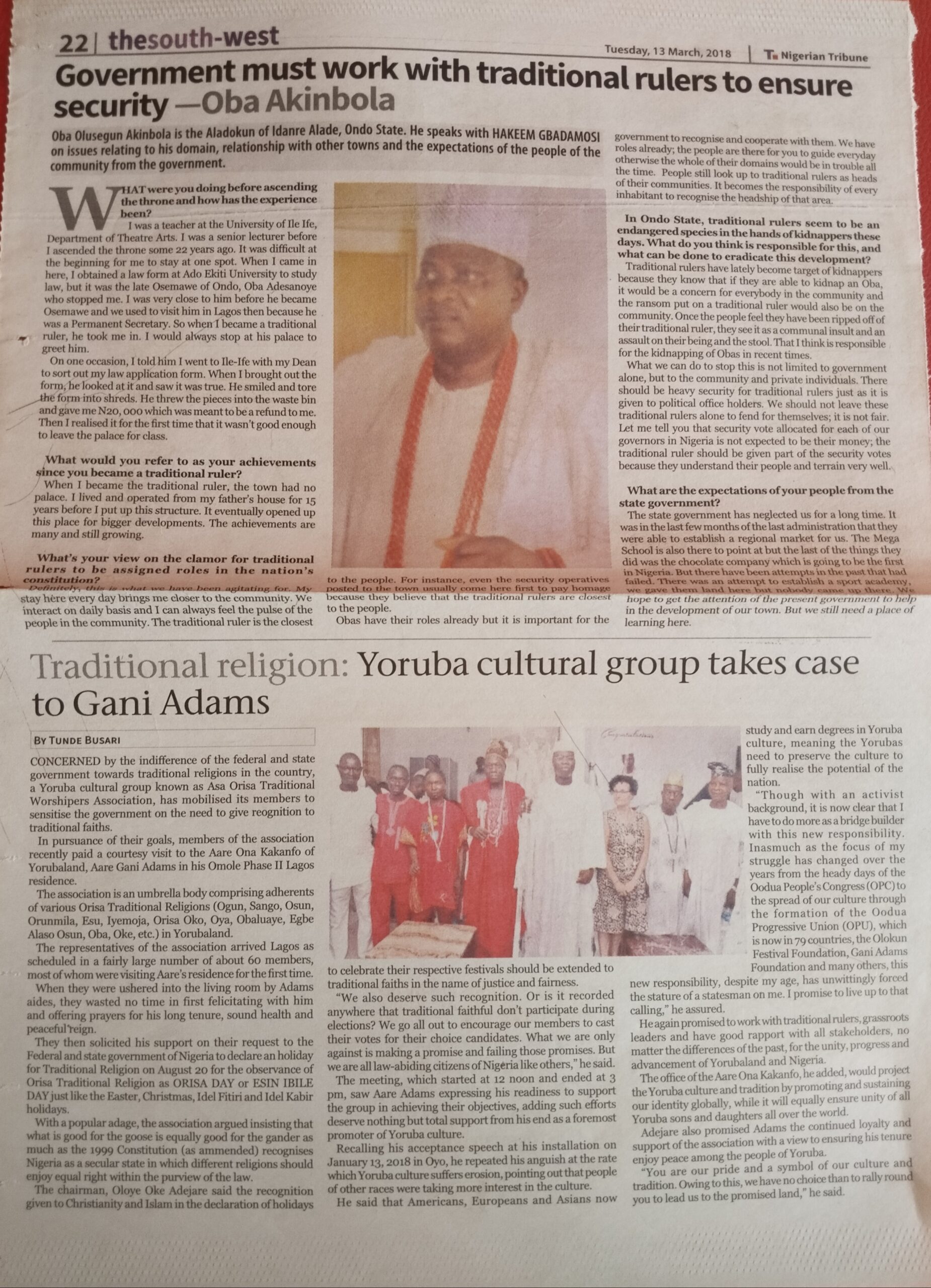
Nigerian Tribune, Tuesday, 13 March, 2018,
CONCERNED by the indifference of the federal and state government towards traditional religions in the country, a Yoruba cultural group known as Asa Orisa Traditional Worshipers Association, has mobilized its members to sensitize the government on the need to give recognition to traditional faiths.
In pursuance of their goals, members of the association recently paid a courtesy visit to the Aare Ona Kakanfo of Yorubaland, Aare Gani Adams in his Omole Phase II Lagos residence. The association is an umbrella body comprising adherents of various Orisa Traditional Religions (Ogun, Sango, Osun, Orunmila, Esu, Iyemoja, Orisa Oko, Oya, Obaluaye, Egbe Alaso Osun, Oba, Oke, etc.) in Yorubaland.
The representatives of the association arrived Lagos as scheduled in a fairly large number of about 60 members, most of whom were visiting Aare’s residence for the first time.
When they were ushered into the living room by Adams aides, they wasted no time in first felicitating with him and offering prayers for his long tenure, sound health and peaceful reign.
They then solicited his support on their request to the Federal and state government of Nigeria to declare an holiday for Traditional Religion on August 20th for the observance of Orisa Traditional Religion as ORISA DAY or ESIN IBILE DAY just like the Easter, Christmas, Eid-del Fitri and Eid-el Kabir holidays.
With a popular adage, the association argued insisting that what is good for the goose is equally good for the gander as much as the 1999 Constitution (as amended) recognizes Nigeria as a secular state in which different religions should enjoy equal right within the purview of the law.
The chairman, Oloye Oke Adejare said the recognition given to Christianity and Islam in the declaration of holidays to celebrate their respective festivals should be extended to traditional faiths in the name of justice and fairness.
“We also deserve such recognition. Or is it recorded anywhere that traditional faithful don’t participate during elections? We all go out to encourage our members to cast their votes for their choice candidates. What we are only against is making a promise and failing those promises. But we are all law-abiding citizens of Nigeria like others,” he said.
The meeting, which started at 12 noon and ended at 3pm, saw Aare Adams expressing his readiness to support the group in achieving their objectives, adding such efforts deserve nothing but total support from his end as a foremost promoter of Yoruba culture.
Recalling his acceptance speech at his installation on January 13, 2018 in Oyo, he repeated his anguish at the rate at which Yoruba culture suffers erosion, pointing out that people of other races were taking more interest in the culture.
He said that Americans, Europeans and Asians now study and earn degrees in Yoruba culture, meaning the Yorubas need to preserve the culture to fully realize the potential of the nation.
“Though with an activist background, it is now clear that I have to do more as a bridge builder with this new responsibility. In as much as the focus of my struggle has changed over the years from the heady days of the Oodua People’s Congress (OPC) to the spread of our culture through the formation of the Oodua Progressive Union (OPU), which is now in 79 countries, the Olokun Festival Foundation, Gani Adams Foundation and many others, this new responsibility, despite my age, has unwittingly forced the stature of a statesman on me. I promise to live up to that calling,” he assured.
He again promised to work with traditional rulers, grassroots leaders and have good rapport with all stakeholders, no matter the differences of the past, for the unity, progress and advancement of Yorubaland and Nigeria.
The office of the Aare Ona Kakanfo, he added, would project the Yoruba culture and tradition by promoting and sustaining our identity globally, while it will equally ensure unity of all Yoruba sons and daughters all over the world.
Adejare also promised Adams the continued loyalty and support of the association with a view to ensuring his tenure enjoy peace among the people of Yoruba.
“You are our pride and a symbol of our culture and tradition. Owing to this, we have no choice than to rally round you to lead us to the Promised Land,” he said.
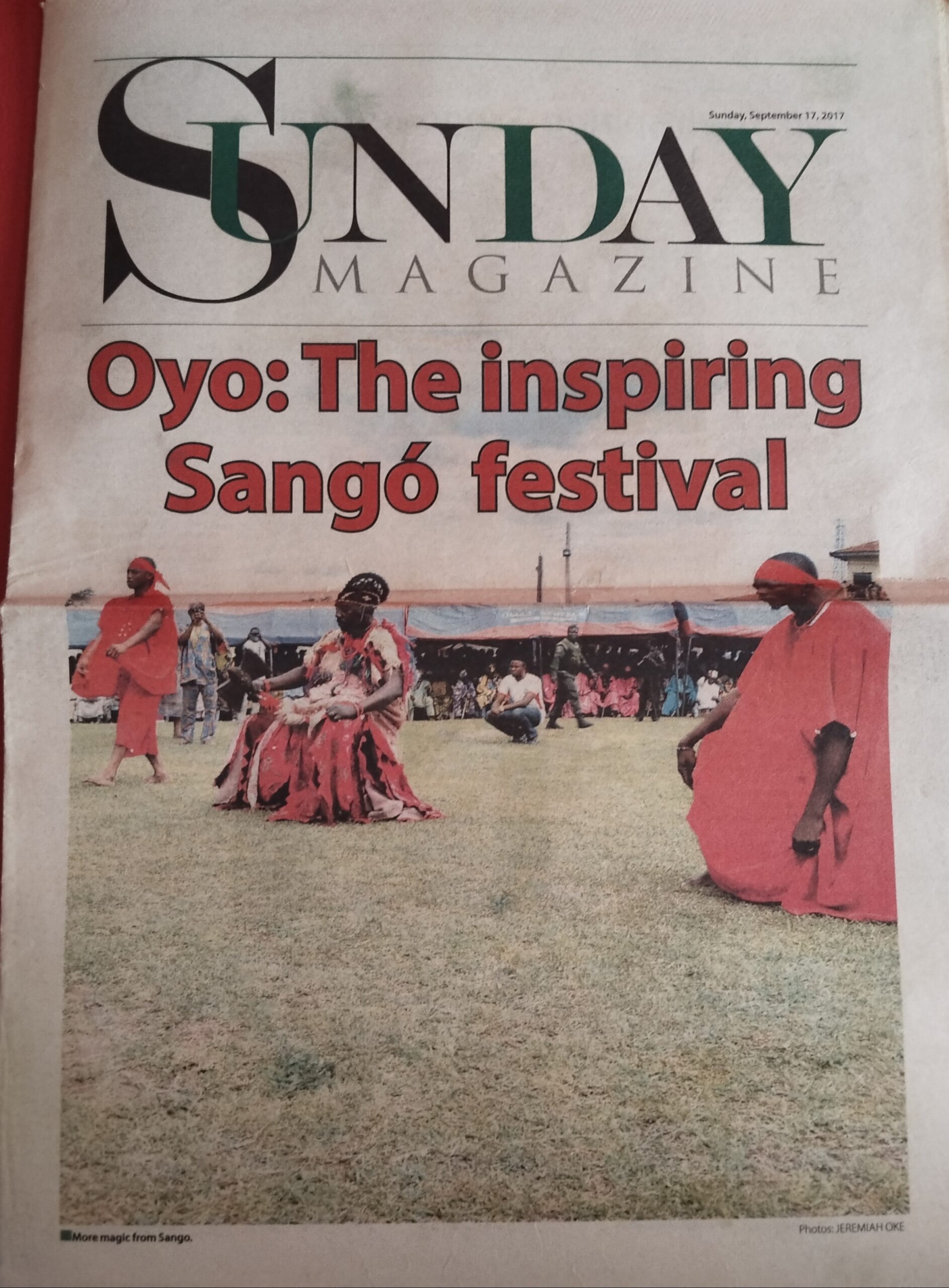
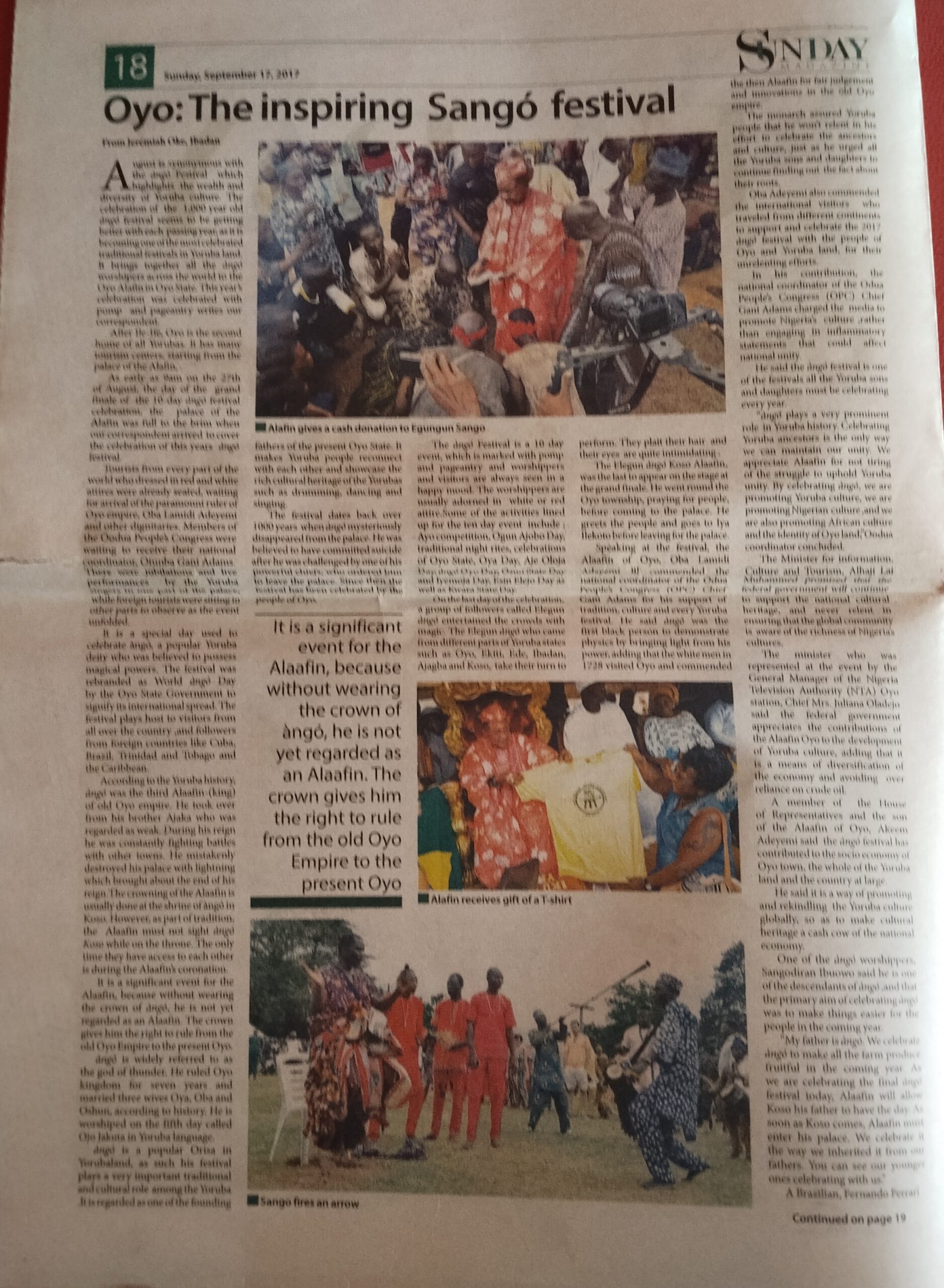
Oyo: The inspiring Sango festival
August is synonymous with the Sango Festival which highlights the wealth and diversity of Yoruba culture. The celebration of the 1,000 year old Sango festival seems to be getting better with each passing year, as it is becoming one of the most celebrated traditional festivals in Yoruba land. It brings together all the Sango worshipers across the world to the Oyo Alafin in Oyo State. This year’s celebration was celebrated with pomp and pageantry writes our correspondent.
After Ile-Ife, Oyo is the second home of all Yorubas. It has many tourism centers, starting from the palace of the Alafin. As early as 9am on the 27th of August, the day of the grand finale of the 10-day Sango festival celebration, the palace of the Alafin was full to the brim when our correspondent arrived to cover the celebration of this year Sango festival.
Tourists from every part of the world who dressed in red and white attires were already seated, waiting for arrival of the paramount ruler of Oyo empire, Oba Lamidi Adeyemi and other dignitaries. Members of the Oodua People’s Congress were waiting to receive their national coordinator, Otunba Gani Adams. There were jubilations and live performances by the Yoruba
singers in one part of the palace, while foreign tourists were sitting in other parts to observe as the event unfolded.
It is a special day used to celebrate Sango, a popular Yoruba deity who was believed to possess magical powers. The festival was rebranded as World Sango Day by the Oyo State Government to signify its international spread. The festival plays host to visitors from all over the country ,and followers from foreign countries like Cuba, Brazil, Trinidad and Tobago and the Caribbean.
According to the Yoruba history, Sango was the third Alaafin-(king) of old Oyo empire. He took over from his brother Ajaka who was regarded as weak. During his reign he was constantly fighting battles with other towns. He mistakenly destroyed his palace with lightning which brought about the end of his reign.The crowning of the Alaafin is usually done at the shrine of Sango in Koso. However, as part of tradition, the Alaafin must not sight Sango Koso while on the throne. The only time they have access to each other is during the Alaafin’s coronation.
It is a significant event for the Alaafin, because without wearing the crown of Sango, he is not yet regarded as an Alaafin. The crown gives him the right to rule from the old Oyo Empire to the present Oyo.
Sango is widely referred to as the god of thunder. He ruled Oyo kingdom for seven years and married three wives Oya, Oba and Oshun, according to history. He is worshiped on the fifth day called Ojo Jakuta in Yoruba language.
Sango is a popular Orisa in Yorubaland, as such this festival plays a very important traditional and cultural role among the Yoruba. It is regarded as one of the founding fathers of the present Oyo State. It makes Yoruba people reconnect with each other and showcase the rich cultural heritage of the Yorubas such as drumming, dancing and singing.
The festival dates back over 1,000 years when Sango mysteriously disappeared from the palace. He was believed to have committed suicide after he was challenged by one of his powerful chiefs, who ordered him to leave the palace. Since then the festival has been celebrated by the people of Oyo.
The Sango Festival is a 10 day event, which is marked with pomp and pageantry and worshippers and visitors are always seen in a happy mood. The worshippers are usually adorned in white or red attire. Some of the activities lined up for the ten day event include Ayo competition, Ogun Ajobo Day, traditional night rites, celebrations of Oyo State, Oya Day, Aje Oloja Day, Sango Oyo day, osun state day and Iyemoja Day, Esin Elejo Day as well known as Kwara state day.
On the last day of the celebration, a group of followers called Elegun Sango entertained the crowds with magic. The Elegun Sango who came from different parts of Yoruba states such as Oyo, Ekiti, Ede, Ibadan. Ajagba and Koso, take their turn to perform. They plait their hair and their eyes are quite intimidating.
The Elegun Sango Koso Alaafin, was the last to appear on the stage at the grand finale. He went round the Oyo township, praying for people, before coming to the palace. He greets the people and goes to Iya Ilekoto before leaving for the palace.
Speaking at the festival, the Alaafin of Oyo, Oba Lamidi Adeyemi ll commended the national coordinator of the Odua People’s Congress (OPC) Chief Gani Adams for his support of tradition, culture and every Yoruba festival. He said Sango was the first black person to demonstrate physics by bringing light from his power, adding that the white men in 1728 visited Oyo and commended the then Alaafin for fair judgment and innovations in the old Oyo empire.
The monarch assured Yoruba people that he won’t relent in his effort to celebrate the ancestors and culture, just as he urged all the Yoruba sons and daughters to continue finding out the fact about their roots.
Oba Adeyemi also commended the international visitors who traveled from different continents to support and celebrate the 2017 sàngó festival with the people of Oyo and Yoruba land, for their unrelenting efforts.
In his contribution, the national coordinator of the Odua People’s Congress (OPC) Chief Gani Adams charged the media to promote Nigeria’s culture, rather than engaging in inflammatory statements that could affect the national unity.
He said the Sango festival is one of the festivals all the Yoruba sons and daughters must be celebrating every year.
“Sango plays a very prominent role in Yoruba history. Celebrating Yoruba ancestors is the only way we can maintain our unity. We appreciate Alaafin for not tiring of the struggle to uphold Yoruba unity. By celebrating Sango, we are promoting Yoruba culture, we are promoting Nigerian culture and we are also promoting African culture and the identity of Oyo land” Oodua coordinator concluded.
The Minister for information, Culture and Tourism, Alhaji Lai Muhammed promised that the federal government will continue to support the national cultural heritage, and never relent in ensuring that the global community is aware of the richness of Nigeria’s cultures.
The minister who was represented at the event by the General Manager of the Nigeria Television Authority (NTA) Oyo station, Chief Mrs. Juliana Oladejo said the federal government appreciates the contributions of the Alaafin Oyo to the development of Yoruba culture, adding that it is a means of diversification of the economy and avoiding Over reliance on crude oil.
A member of the House of Representatives and the son of the Alaafin of Oyo, Akeem Adeyemi said the Sango festival has contributed to the socio economy of Oyo town, the whole of the Yoruba land and the country at large.
He said it is a way of promoting and rekindling the Yoruba culture globally, so as to make cultural heritage a cash cow of the national economy.
One of the Sango worshippers, Sangodiran Ibuowo said he is one of the descendants of Sango, and that the primary aim of celebrating Sango was to make things easier for the people in the coming year.
“My father is Sango. We celebrate Sango to make the entire farm produce fruitful in the coming year. As we are celebrating the final Sango festival today, Alaafin will allow Sango Koso his father to have the day. As soon as Sango Koso comes, Alaafin must enter his palace. We celebrate it
the way we inherited it from our fathers. You can see our younger ones celebrating with us.”
A Brazilian, Fernando Ferrari said he was in Nigeria to see the real spirit of the Sango celebration, saying it was amazing and interesting seeing the real sango celebration in Nigeria
He noted that he was returning to Brazil with a lot of new ideas about the Yoruba culture and
tradition, Nigeria remains one of the countries with a very rich culture in the world, he noted.
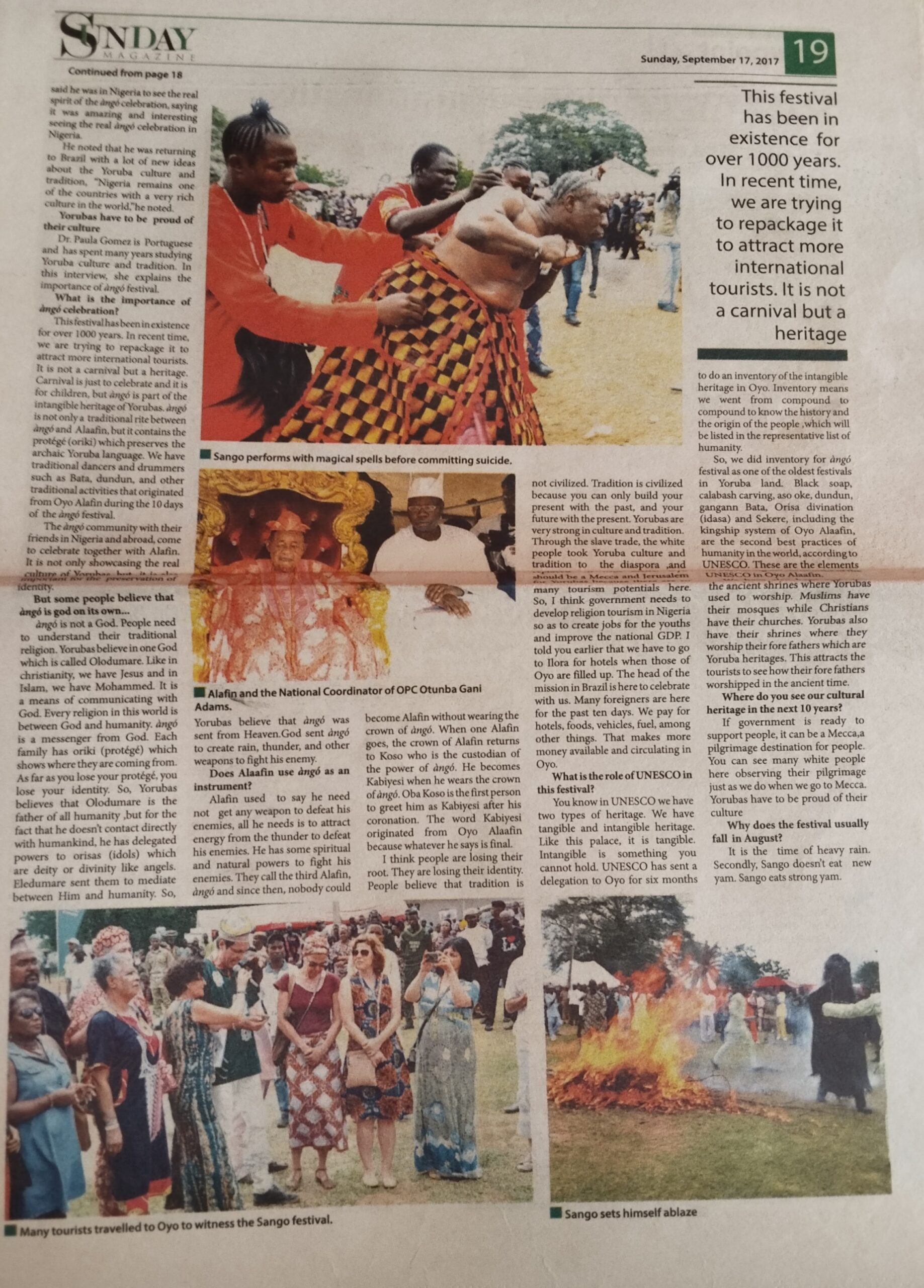
Yorubas have to be proud of their culture.
Dr Paula Gomez is Portuguese and has spent many years studying Yoruba culture and tradition. In
this interview, she explains the importance of Sango festival.
What is the importance of Sango celebration?
This festival has been in existence for over 1000 years. In recent time, we are trying to repackage it to attract more international tourists. It is not a carnival but a heritage. Carnival is just to celebrate and it is for children, but Sango is part of the intangible heritage of Yorubas. Sango is not only a traditional rite between Sango and Alaafin, but it contains the protégé (oriki) which preserves the
archaic Yoruba language. We have traditional dancers and drummers such as Bata, dundun, and other traditional activities that originated from Oyo Alafin during the 10 days of the Sango festival.
The Sango community with their friends in Nigeria and abroad, come to celebrate together with Alafin. It is not only showcasing the real culture of Yorubas but it is also important for the preservation of identity.
But somne people believe that Sango is god on its own…
Sango is not a God. People need to understand their traditional religion. Yorubas believe in one God which is called Olodumare. Like in Christianity, we have Jesus and in Islam, we have Mohammed. It is a means of communicating with God. Every religion in this world is between God and humanity. Sango is a messenger from God. Each family has oriki (protégé) which shows where they are coming from.
As far as you lose your protégé, you lose your identity. So, Yorubas believes that Olodumare is the
father of all humanity, but for the fact that he doesn’t contact directly with humankind, he has delegated powers to orisas (idols) which are deity or divinity like angels. Eledumare sent them to mediate between Him and humanity. So, Yorubas believe that Sango was sent from Heaven. God sent Sango to create rain, thunder, and other weapons to fight his enemy.
Does Alaafin use Sango as an instrument?
Alafin used to say he need not get any weapon to defeat his enemies; all he needs is to attract
energy from the thunder to defeat his enemies. He has some spiritual and natural powers to fight his
enemies. They call the third Alafin, Sango and since then, nobody could become Alafin without wearing the crown of Sango. When one Alafin goes, the crown of Alafin returns to Koso who is the custodian of the power of Sango. He becomes Kabiyesi when he wears the crown of Sango. Oba Koso is the first person to greet him as Kabiyesi after his coronation. The word Kabiyesi originated from Oyo Alaafin because whatever he says is final.
I think people are losing their root. They are losing their identity. People believe that tradition is not civilized. Tradition is civilized because you can only build your present with the past, and your future with the present. Yorubas are very strong in culture and tradition. Through the slave trade, the white people took Yoruba culture and tradition to the Diaspora, and replaced it with theirs. Oyo should be a Mecca and Jerusalem for Yorubas because there are so many tourism potentials here.
So, I think government needs to develop religion tourism in Nigeria so as to create jobs for the youths and improve the national GDP. I told you earlier that we have to go to Ilora for hotels when those of Oyo are filled up. The head of the mission in Brazil is here to celebrate with us. Many foreigners are here for the past ten days. We pay for hotels, foods, vehicles, fuel, among other things. That makes more money available and circulating in Oyo.
What is the role of UNESCO in this festival?
You know in UNESCO we have two types of heritage. We have tangible and intangible heritage.
Like this palace, it is tangible. Intangible is something you cannot hold. UNESCO has sent a delegation to Oyo for six months to do an inventory of the intangible heritage in Oyo. Inventory means we went from compound to compound to know the history and the origin of the people, which will be listed in the representative list of humanity.
So, we did inventory for Sango festival as one of the oldest festivals in Yoruba land. Black soap,
calabash carving, aso oke, dundun, gangann Bata, Orisa divination (idasa) and Sekere, including the
kingship system of Oyo Alaafin, are the second best practices of humanity in the world, according to
UNESCO. These are the elements we did during the six months of the UNESCO in Oyo Alaafin.
We have also been restoring the ancient shrines where Yorubas used to worship. Muslims have
their mosques while Christians have their churches. Yorubas also have their shrines where they
worship their fore fathers which are Yoruba heritages. This attracts the tourists to see how their fore fathers worshipped in the ancient time.
Where do you see our cultural heritage in the next 10 years?
If government is ready to support people, it can be a Mecca, a pilgrimage destination for people.
You can see many white people here observing their pilgrimage just as we do when we go to Mecca.
Yorubas have to be proud of their culture
Why does the festival usually fall in August?
It is the time of heavy rain. Secondly, Sango doesn’t eat new yam. Sango eats strong yam.